
Top 10 AI Video Analytics Companies in India for 2026 for Smart Surveillance
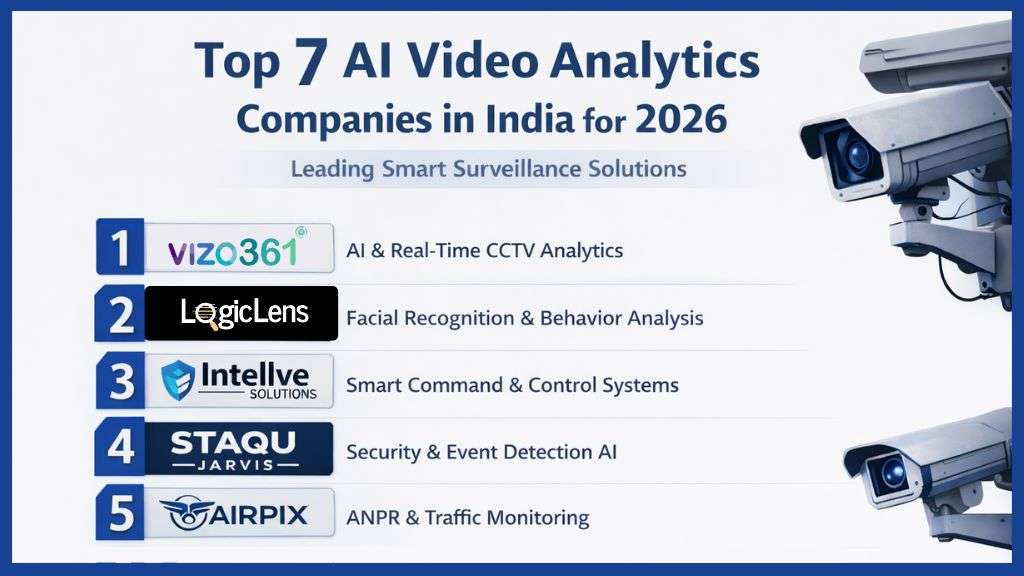
AI-enabled video analytics has rapidly emerged as one of the most revolutionary technologies in today’s security, surveillance, and intelligent monitoring domains. Camera networks are increasing at an exponential rate across all sectors, thus the organizations are relying on advanced, automated systems to get meaningful insights from the video feeds in a cost-effective, timely, and accurate manner. On the other hand, traditional video monitoring methods are totally dependent on human judgment which is not only labor-intensive but also expensive and prone to mistakes. This is the point where AI video analytics, video management systems, and intelligent video surveillance platforms are providing a substantial benefit. While the AI Video Analytics Companies in India are trying to identify the best AI-based video analytics vendors and compare the AI video analytics software, getting a clear picture of the industry is very important. The present article discusses the definition of AI video analytics, its working, the advantages it offers, the major industry applications, the drawbacks, and a detailed account of the top companies in the video analytics market in 2025. Moreover, it provides a comparison of the main platforms and tips for selecting the best one, as well as the position of Proeffico Solutions and its Vizo361° platform in this ever-expanding sector. What is AI-Powered Video Analytics? AI-Powered video analytics is the technology that uses artificial intelligence, machine learning, and deep learning to automatically analyze video feeds and extract meaningful data. Instead of relying on human operators to monitor screens, AI continuously scans video in real-time to detect patterns, behaviors, anomalies, and events of interest. It can identify objects, track movements, recognize faces, classify activities, and trigger alerts with an accuracy level far higher than traditional systems. In simple words, AI-powered video analytics transforms ordinary cameras into intelligent sensors that can comprehend what is happening in the video. AI video analytics software, for instance, has numerous applications, including intrusion detection, retail foot traffic monitoring, and safety hazard identification, thus enhancing operational efficiency along with stronger security. How AI-Powered Video Analytics Works AI-powered video analytics operates through the integration of computer vision, neural networks, and data processing pipelines. The whole procedure usually begins with video digestion, where the system collects live or archived videos from various sources like security cameras, drones, mobile devices, or video management systems. Deep learning models are then tasked with analyzing the incoming frames and classifying objects including, but not limited to, vehicles, people, bags, equipment, or machinery. In conjunction with tracking algorithms, the system monitors movements, determines the norms, and isolates the suspects or the abnormal behavior. The latest AI video management systems are capable of reading detailed environments, getting the gist, and even forecasting the possibilities of incidents.Human specialists train the artificial intelligence using millions of tagged video samples until they can identify actions and objects with great accuracy. Key Benefits of AI-Powered Video Analytics The main advantages of AI-powered video analytics are many. One major advantage is the quick identification of incidents in real-time. While human monitoring with cameras would be needed for the watching of dozens or even hundreds of cameras, AI can quickly detect and signal atypical incidents. This leads to faster responses to the incidents and lower risks of missing important activities. Another advantage is the operational sufficiency. Enterprises are able to use the services of video analytics companies to completely take over boring and dull monitoring processes, then getting the benefits of more efficient workflows and less personnel costs. Besides, the use of AI gives the highest precision when compared to human viewing, as AI doesn’t get tired, distracted, or have a misperception. AI video analytics provides valuable business intelligence such as heat maps, customer movement patterns, production efficiency, and compliance reporting. In retail and manufacturing, it helps understand customer behavior and optimize operational workflows. AI video management systems improve organizational safety while enforcing internal policies. The system supports long-term strategic decision-making by using historical video data and analytics. AI-powered surveillance records only important events instead of continuous footage, reducing storage costs. It enables smarter monitoring with real-time alerts and actionable insights. Compliance tracking becomes easier with automated detection and reporting. Overall, AI video analytics secures operations, boosts efficiency, and enhances data-driven decisions across industries. Industry Use Cases AI Video Analytics Companies in India is transforming many different sectors beyond security, operational intelligence, and automation. In the retail industry, it can be employed to monitor the number of people entering and leaving the store, understand the customers’ purchasing habits, and prevent shoplifting, and the store layout can be more effectively arranged based on the findings. It is common to see the application of AI in video analytics in factories to make sure the safety rules are followed, to guard against dangerous situations such as workers getting into areas they should not be in, and to spot the anomalous behavior of machinery. One use of AI video analytics in smart cities is to detect and control the traffic flow, identify the location of an accident, have a view of the areas where the public moves and use that information to support law enforcement cooperation. Manufacturing use AI video analytics for continuous patient monitoring, fall detection, and securing areas with sensitive materials. It enhances patient safety by enabling real-time alerts and proactive intervention. Logistics companies leverage AI video surveillance to identify untrackable or misplaced packages. AI systems help monitor loading bays and ensure goods are handled under proper conditions. In airports and transportation hubs, intelligent video analytics manages crowd flow and improves safety. It enables abandoned baggage detection to prevent security risks. Hospitality venues use AI video analytics to ensure a smooth and personalized customer experience. Due to its multifunctional capabilities, AI video analytics has become a non-replaceable resource across industries. Limitations and Considerations AI video analytics comes with a wide range of limitations and disadvantages. Environmental issues are one of the factors that can impact the accuracy which includes poor lighting, occlusion, camera angle issues, and heavy rain or fog. If organizations are to achieve
7 Best Cloud-Based Security Camera Systems to Protect Your Business in 2026
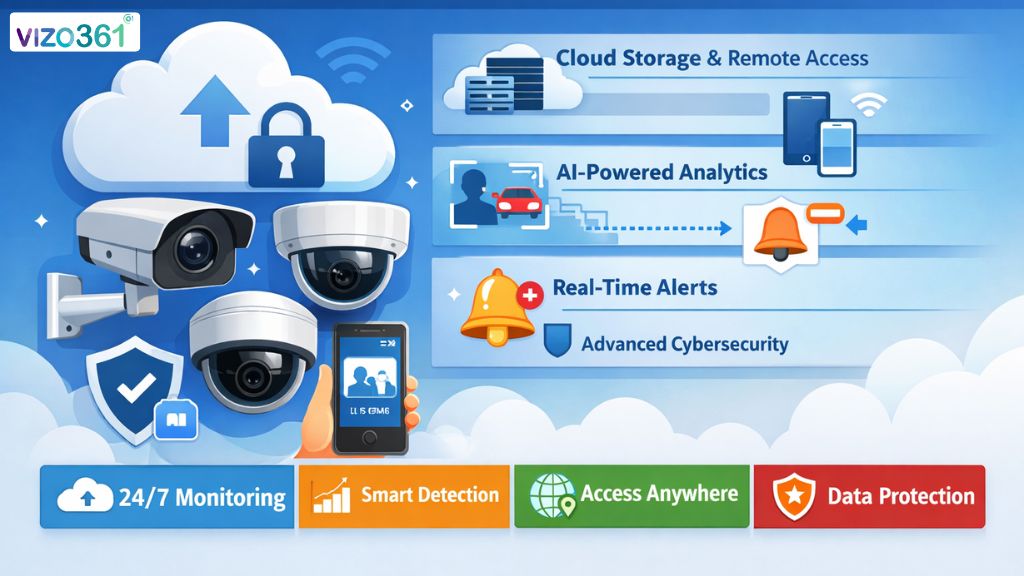
The shift in security has been tremendous; It is no longer a matter of grainy videos and locked servers. Nowadays, all types of businesses re-evaluate their ways of monitoring people, places, and operations with cloud-enabled CCTV cameras as the main tool. Cloud storage for modern security cameras eliminates hardware-dependent surveillance systems from the past and allows for flexible, intelligent, and scalable video security that can be accessed anywhere. Cloud-based security cameras offer companies the chance to watch places from afar, do away with large on-site servers, and reveal AI-powered insights that surpass the limits of conventional monitoring utterly. Throughout this guide, we will elaborate on the weaknesses of the older systems, clarify the working of the camera systems through the cloud, compare the most significant platforms—including enterprise solutions such as Proeffico Solutions’ Vizo361°—and help you figure out how to select the right option for your company. How Traditional Security Camera Systems Miss the Mark The traditional CCTV systems—analog cameras, DVRs, and NVRs—were mainly made for after-the-fact investigations. They still have the ability to deter crime, but in the case of modern fast and continuously changing multi-location business settings, they will soon become useless. The companies with the on-premises systems can only use the proprietary hardware. They need to lay out complicated wiring, and they have to rely on local storage devices that can be easily stolen, damaged, or fail. Scaling means buying new recorders and servers, and remote access often means employing VPNs and IT personnel who work exclusively with you. The most significant drawback of these systems is that they do not provide any intelligence, other than raw footage. As organizations require security that can predict proactive moves, operational visibility, and workflow automation, traditional CCTV killers have been a bottleneck not an enabler. Why Cloud-Based Security Cameras Are Transforming Surveillance As per the Bureau of Labor Statistics, the physical security sector is on an upward trend and continues to draw the attention of companies wanting to protect both personnel and physical assets more securely. AI, on the other hand, is changing the whole video surveillance scenario by making the cameras real-time data sources. This means that the AI will support safety, compliance, and operational performance in a non- intrusive way. Cloud camera taking this approach, gets rid of a lot of limitations which were the reason of the legacy systems. The video is first transmitted securely to the cloud, and then it can be accessed, searched, and analyzed using AI. Vizo361° from Proeffico Solutions is one of the platforms that takes this a step further by doing video analytics not only in security but also in other areas like customers, operations, marketing, etc. Now, companies are not dependent on cameras merely for probing incidents. They have started using AI based video insights to enhance productivity, maintain the safety standards, spot anomalies, and improve the process by automating the department’s interconnected workflows. Cloud Based Security Camera Systems Explained A cloud-based security camera system refers to any camera network that is connected to the internet and backed up to a secure cloud infrastructure for video storage instead of being supported by local recorders only. When compared with traditional analog CCTV, DVR, or NVR systems, cloud-based solutions have the following advantages: Footage is streamed over the internet for access via web or mobile apps It is easily scalable by just adding licenses instead of servers On-site hardware, wiring, and maintaining are less Management is centralized across different locations And AI is there all along for helping in searching, making alerts, and performing analytics A few enterprise-class platforms, like Proeffico’s Vizo361°, are employing a hybrid edge-and-cloud architecture. The video is being processed at the edge for real-time insights and low latency, while the cloud storage is used for long-term retention, centralized analytics, and enterprise-wide. Key Benefits of Security Camera Cloud Storage for Businesses Remote Access and Centralized Video Management By using security camera cloud storage, users with proper authorization can watch live or recorded video from any place. A single regional manager is able to monitor the safety compliance across ten different facilities using just one dashboard and without requiring any VPNs or local servers. Reduced Risk of Data Loss Cloud storage ensure that the very important video evidence is kept in a different place, thus in case of any theft, fire, or hardware failure it will be safe. The best providers have data duplication in several data centers. Hybrid systems make sure that footage is recorded locally if there is a disconnection. Simplified Footage Sharing and Collaboration Today’s platforms allow users to cut, label, and share securely incidents in a matter of seconds. AI-powered systems like Vizo361° even more facilitate investigations by offering features such as object detection, activity analysis, and anomaly detection—which cuts down the need for manual review. Lower Reliance on Expensive On-Premise Hardware Thanks to cloud or edge for processing and storage, organizations can adopt cheap IP cameras with forbearance towards onsite infrastructure. Improved Monitoring and Proactive Maintenance Alerts inform the teams before a camera fails which helps in reducing blind spots and downtime. In the case of large-scale deployments, this proactive measures greatly enhances the operational resilience. System Deep Dive Vizo361° AI Vizo361° is an adaptable and AI-driven video analytics engine that can be utilized in various fields like surveillance or others. It has the capability to perform large-scale object detection, intrusion detection, PPE compliance, vehicle tracking, activity analysis, face recognition and anomaly detection. Vizo361’s strongest point is its dependence on existing systems, edge devices for real-time analysis, and development of AI models that fit business workflows perfectly. It adds more versatility to traditional one-dimensional video analytics software by bringing together security intelligence and workflow automation. Spot AI Spot AI, with its quick installation and a user-friendly interface, can convert video clips into actionable intelligence. The system consists of intelligent video recorders connected to the cloud, where data is stored, and AI-powered search is performed. Rhombus Rhombus is providing a cloud-based video management system with extensive API
Shipment Received Package Acceptance Pending
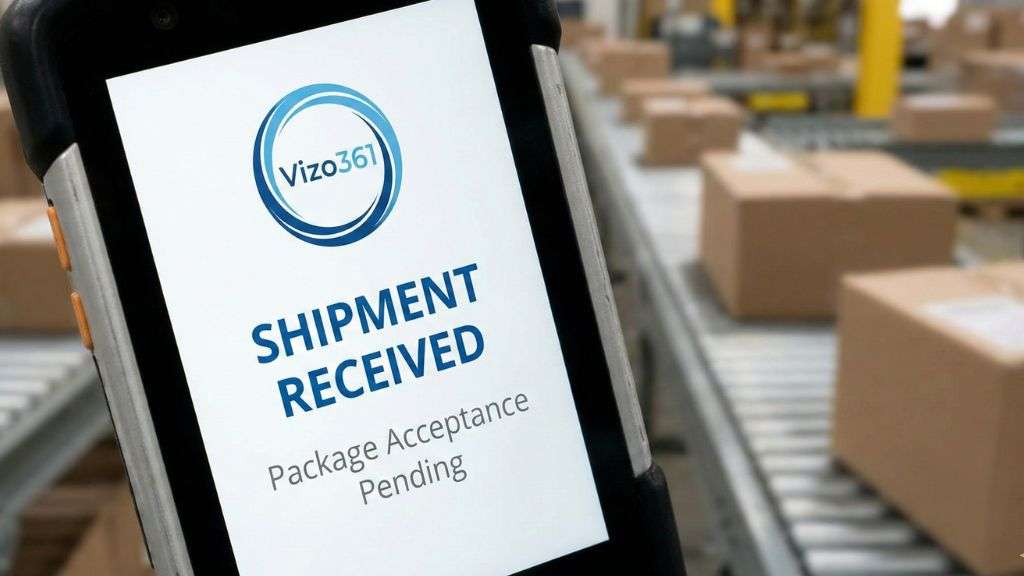
Whenever someone tracks a package in India, through any courier service, they can see a confused update: “Shipment Received, Package Acceptance Pending.” This status often raises questions: Has the courier actually received the package? Why isn’t there a new scan? Is my order delayed? This message appears frequently across both government and private courier tracking systems and is often misunderstood by online shoppers. With the rise of e-commerce giants like Amazon, Flipkart, and Meesho—and millions of daily shipments—Indian distribution hubs have become extremely busy, making this update even more common. This blog explains what package acceptance pending means in India, why delays happen, how different Indian hubs operate, and how advanced logistics technology like Vizo361° can dramatically improve visibility and speed across Indian courier networks. What Does “Shipment Received, Package Acceptance Pending” Mean in India? This status appears when a package has been received at a courier facility but has not been officially scanned yet. This applies to both India Post and private courier companies. You may also see similar messages such as: “The acceptance of your package is pending” “Package accepted pending” “Shipment received package acceptance pending” All these indicate one thing: your cargo is at the still under facility and scanning is pending. Why Does This Happen? Reasons Specific to Indian Logistics India’s logistics ecosystem is extremely busy and diverse. Acceptance delays happen due to the following: High Volume at Major Indian Distribution Centers: During festival and sale seasons, the large Indian distribution centers, the Delhi RMS/NSH, Mumbai Air Mail Sorting Centre, Bengaluru Sorting Hub, Hyderabad NSH, and Chennai RMS, get tens of thousands of shipments every hour and even more. Manual Scanning at India Post: India Post is still highly dependent on manual sorting, manual scanning, and the use of physical bag manifests. These practices, in combination with the slow acceptance updates, are the main cause of the latter coming about. Hub Cut-Off Timings: The daily cutoff time for packages is usually set between 8 PM-10 PM. Any package arriving after this daily cut-off time is scanned only the next day. Internal Routing Delays: Within the hubs, packages could be delayed waiting for any of the following processes to be completed, i.e., quality checks, weight and size verification, sorting belt availability, or routing to zone-wise bins. Inconsistent Infrastructure: Acceptance delays can become long when smaller cities and rural hubs do not have automated sorting machines, high-speed conveyors, and digital manifests. How Long Does Package Acceptance Take in India? India Post: Typically 12–48 hours; during peak seasons 24–72 hours due to manual processes. Private Couriers: Delhivery / XpressBees / Ecom Express: 6–24 hours Blue Dart / FedEx (premium services): 2–12 hours Even if a package remains in acceptance pending for 2–3 days, it is still normal in the Indian context. Common Indian Hubs Where Acceptance Delays Happen India Post Hubs: Delhi NSH, Mumbai AMPC, Kolkata RMS, Bengaluru NSH, Hyderabad NSH Private Courier Hubs: Delhivery Gurgaon Mega Hub, XpressBees Pune Hub, Ecom Express Gurgaon Center, Blue Dart Bhiwandi Hub, DTDC Peenya Hub Packages often remain in “shipment received, package acceptance pending” at these hubs due to extremely high daily load. Why E-Commerce in India Makes This Status More Common India’s booming online shopping ecosystem creates: 8–10 million parcels shipped daily Millions of small sellers depending on logistics partners Rapid growth in developed or developing cities This results in more pickups, more drop-offs, more hub congestion, and more acceptance delays. This is exactly where Vizo361° brings massive value to the Indian logistics ecosystem. How Vizo361° Improves Package Acceptance for Indian Couriers & Sellers Vizo361° is a logistics visibility and automation system that harnesses the power of AI and is created to address issues specific to India like missing scans, processing delays, hub congestion, unpredictable delivery timelines, and lost/misrouted shipments. Key benefits include: Real-Time Visibility Before Acceptance Scans: Vizo361° tracks pre-scan events, internal hub movements, pickup data, and digital manifests—providing updates before official scans appear. Smart Predictions for Acceptance Times: Using machine learning trained on India Post NSH data, private courier patterns, seasonal spikes, and regional bottlenecks, Vizo361° predicts acceptance times and flags possible delays. Automatic Delay Alerts: In case a shipment does not move out of “acceptance pending” for too long, Vizo361° will send immediate alerts, make the issue hubs visible, and if need be, propose the option of rerouting. End-to-End Courier Integrations: Vizo361° has a connection with India Post, Delhivery, Blue Dart, DTDC, Ekart, XpressBees, and Ecom Express to coordinate the manifests, conduct scans without mismatches, and to accept parcels faster. Optimizing Seller Workflows: It is the process of confirming labels, barcodes, weight, digital manifests, and packaging—thereby lessening rejections at acceptance. Better Customer Experience: Vizo361° offers timely delivery forecasts, tracking that is up to the minute, and alerts for delays that are given beforehand, thus making customers easier to manage and lowering the number of support calls. How Vizo361° Works Across the Indian Shipment Lifecycle During Label Creation: Vizo361° verifies measurements, barcodes, and serviceability—reducing acceptance-stage errors. During Drop-Off at Courier Hub: It tracks inward scans, pickup partner performance, and bag manifests for faster queue movement. During Acceptance Pending: It provides predictions, delay alerts, hub insights, and performance dashboards for full transparency. After Acceptance: It syncs with courier systems to instantly update the merchant. During Transit & Delivery: It improves routing, SLA adherence, return logistics, and NDR management—common issues in India. Conclusion: Vizo361° Makes Indian Logistics Faster, Transparent & More Predictable The status “Shipment Received, Package Acceptance Pending” is extremely common in India. It simply indicates that the courier has your parcel but hasn’t scanned it yet. However, India’s growing e-commerce ecosystem demands: faster acceptance better visibility fewer tracking gaps more reliable logistics Vizo361° solves all of these challenges. By bringing AI-driven tracking, predictive intelligence, real-time alerts, and workflow automation to India Post and private courier operations, Vizo361 ensures smoother package acceptance, reduced delays, and improved customer satisfaction. FAQs in the Indian Context 1. My India Post tracking says “Acceptance Pending” for 2 days. Normal? Yes. India Post accepts shipments slowly,