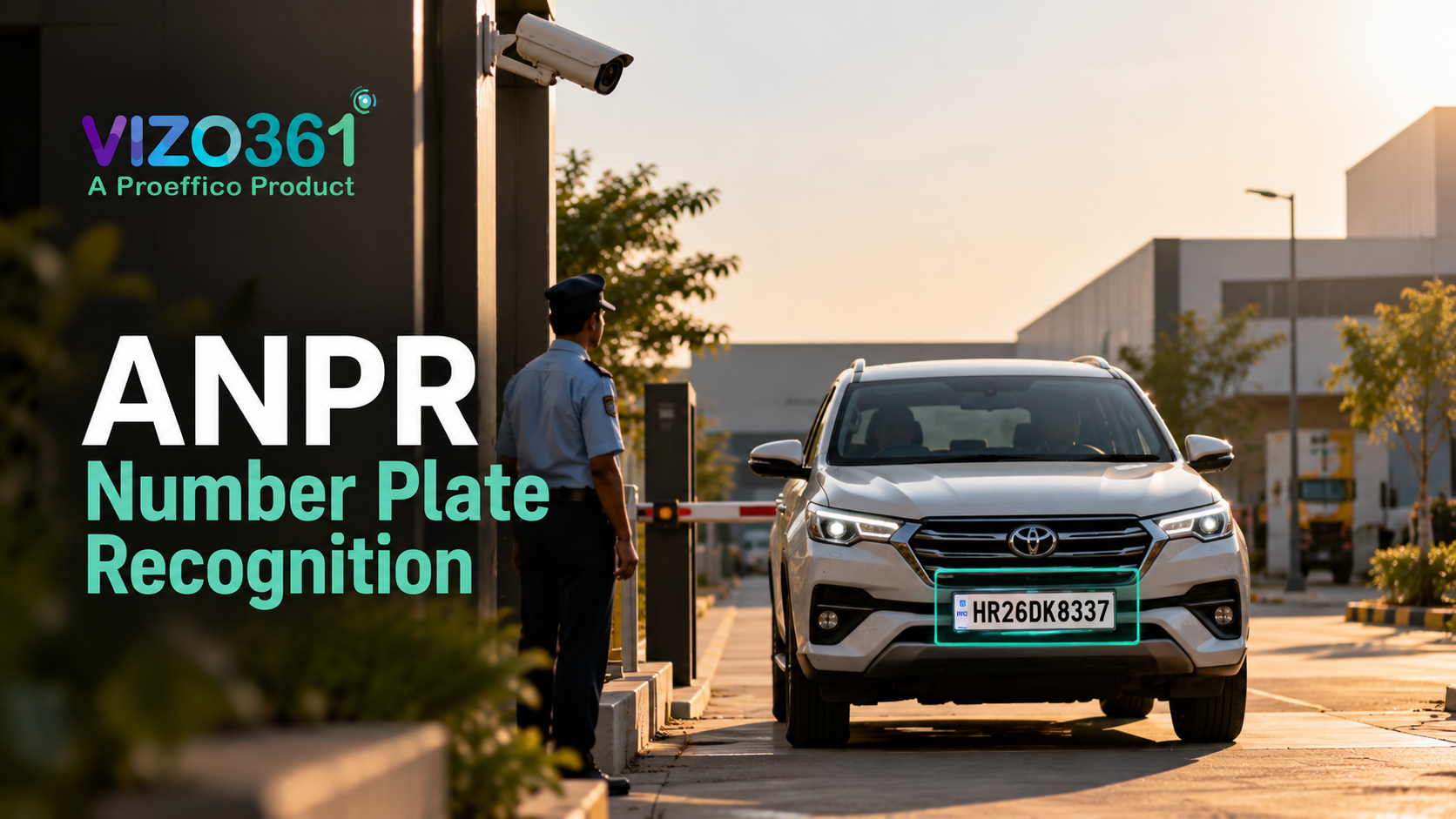
Every gate, parking lot and dispatch bay in India already has a camera pointed at the vehicles moving through it. Most of that footage is never looked at unless something goes wrong. ANPR (Automatic Number Plate Recognition) turns that same footage into a live, searchable log of every vehicle that entered, left or lingered — without a single new pole or barrier arm. This guide covers what ANPR actually does, where it earns its keep on Indian sites, and what to check before you commit to a vendor. ## What ANPR Is, in Plain English ANPR number plate recognition in India means software that reads a vehicle's registration plate from a live camera feed and converts it into text — instantly, and at whatever volume of traffic your gate sees. Once a plate is read, it can be: - Matched against an allow-list (staff, tenants, contractors) or a blacklist - Logged with a timestamp, direction (in/out), and a snapshot of the vehicle - Linked to a visitor record, a delivery challan, or a parking session It's the same underlying idea as license plate recognition used for tolling or traffic enforcement — applied instead to a factory gate, a mall basement, a warehouse yard, or a residential society. ## How Number-Plate Recognition Works At a technical level, ANPR is a pipeline, not a single trick: 1. **Detection** — the system locates the plate within the video frame, separating it from the rest of the vehicle and background. 2. **Recognition (OCR)** — it reads the characters on the plate, including India's mix of white (private), yellow (commercial), and green (electric) plate formats. 3. **Validation** — the read text is checked against expected Indian plate formats to catch OCR errors before they're logged. 4. **Action** — the result triggers whatever you've configured: open the barrier, raise an alert, write a log entry, or do nothing but record. The part most buyers underestimate is step 3. A system that reads plates well in a demo video but has no validation logic will happily log a garbled plate as fact. That gap is where false matches and bad audit trails come from. VIZO361's ANPR module is built to run on the cameras a site already has — the same "See everything. Miss nothing." approach behind our other [AI CCTV analytics for warehouses](https://vizo361.ai/blogs/ai-cctv-analytics-for-warehouses), footfall, and fire/smoke modules. If your existing gate camera has a reasonable line of sight and resolution, there's usually no need to rip it out and install purpose-built ANPR hardware. ## Use Cases: Gates, Parking, Logistics ANPR shows up in a handful of recurring scenarios across Indian sites: **Factory and campus gates.** Every vehicle in and out gets logged automatically, which replaces (or backs up) a manual gate register. Security staff can see, in real time, whether an unregistered vehicle is trying to enter, without depending on a guard remembering a list. **Parking management.** Malls, hospitals, and office parks use ANPR to time-stamp entry and exit without issuing a ticket, calculate parking duration automatically, and flag vehicles that overstay. It also cuts down on the manual reconciliation that parking operators do at shift-end. **Logistics and dispatch yards.** Warehouses and distribution centres use ANPR to confirm that the truck at the dock matches the vehicle number on the dispatch order, log dwell time at the gate and at the dock, and build a vehicle movement history that's useful when a shipment is disputed later. **Visitor and contractor management.** Combined with a visitor log, ANPR can auto-populate the vehicle number field instead of relying on a security guard to type it in — which is where a surprising number of gate registers go wrong. **Blacklist and repeat-offender tracking.** Retail chains and residential societies use it to flag vehicles previously involved in an incident, without needing anyone on duty to recognise the car by sight. If your site also deals with queues at billing counters or entry points, it's worth pairing this with [queue management with video analytics](https://vizo361.ai/blogs/queue-management-with-video-analytics) — the two problems (who's coming in, and how long they wait) often sit on the same camera. ## Accuracy and Conditions That Matter ANPR accuracy isn't a single number a vendor can promise you in the abstract — it depends heavily on site conditions. Before signing anything, get clarity on how the system performs under: - **Low light and night conditions** — many Indian gates operate 24/7, and plate reads degrade without adequate IR illumination or a camera rated for low light. - **Camera angle and mounting height** — plates read best when the camera has a near-frontal view; a steep angle from a high pole hurts accuracy. - **Vehicle speed** — a barrier-gate entry moving at walking pace is a very different problem from a highway feed; make sure the system is tuned for your actual traffic speed. - **Plate condition** — India has a wide range of plate formats and conditions in the field: non-standard fonts, dirty or bent plates, stylised characters on private vehicles, and inconsistent enforcement of the standard HSRP format. A system that assumes clean, standard plates will underperform on the ground. - **Weather and glare** — rain, fog, and direct sun glare on the plate all affect read rates, especially on open yards and outdoor parking. Ask any vendor for their real-world accuracy figure on a comparable site, not a lab number — and ask specifically about low-light and non-standard-plate performance, since that's where most systems lose the most ground. The figure that matters is the one measured on your own gate, in your own light, so treat a site trial on your cameras as part of the evaluation rather than taking any headline number on trust. Also worth asking: what happens when a plate is misread? A system with no manual-override or exception queue means a bad read either wrongly blocks a legitimate vehicle or wrongly lets one through — neither of which you want at a factory gate. ## How to Choose A short checklist for evaluating an ANPR vendor for an Indian site: - **Works on your existing cameras.** Confirm the system doesn't require you to replace working CCTV infrastructure — that's a large, avoidable cost. - **Handles Indian plate variety.** Ask for a demo on your own site's camera feed, including night footage, not a curated sample reel. - **Integrates with what you already run.** Gate barriers, visitor management, parking software, or your ERP dispatch module — ANPR is most useful when it feeds data into a system you already check daily. - **Gives you a real log, not just an alert.** You'll want a searchable history (by plate, date range, or direction) for audits, disputes, and security reviews — not just a live pop-up that disappears. - **Has a sane exception process.** Misreads will happen. Know how the system flags them and how a guard resolves them without holding up the gate. - **Data handling is clear.** Vehicle logs are personal data under Indian data-protection norms; ask how long footage and plate logs are retained and who can access them. - **Certifications and security posture.** For BFSI, government, or large enterprise sites, ISO 27001 certification on the vendor's data handling is worth confirming upfront. VIZO361 runs ANPR as one module within a broader AI video analytics platform — alongside footfall, fire/smoke detection, and safety modules like the ones covered in [video analytics for manufacturing safety](https://vizo361.ai/blogs/video-analytics-for-manufacturing-safety) — so a single gate camera can do more than one job instead of needing a separate system for each. ## Frequently Asked Questions ### Does ANPR work with India's non-standard number plates? It should, but not all systems handle the variety well. Indian plates include stylised fonts on older private vehicles, non-HSRP formats still in circulation, and commercial yellow and electric green plates alongside the standard white ones. Ask a vendor to test on footage from your own gate — including a mix of vehicle types — before committing, rather than relying on a demo reel of clean plates. ### Can ANPR run on the CCTV cameras we already have? Often, yes — if the existing camera has adequate resolution, a reasonably frontal angle on the vehicle, and enough light (or IR support) for night reads. That's the model VIZO361 is built around: adding ANPR as a module on your existing camera infrastructure rather than requiring dedicated hardware at every gate. ### How accurate is ANPR at night or in bad weather? Accuracy drops without proper low-light handling, and further with rain, fog, or glare. This is the single biggest gap between a demo-video accuracy claim and real-world performance. Always ask for accuracy figures specific to night and adverse-weather conditions, not just daytime numbers — and insist on a trial read on your own night footage before you commit, since that is the only number that reflects your actual site. ### What happens when the system misreads a plate? A well-built ANPR setup flags low-confidence reads for manual review rather than silently acting on a bad guess — for example, holding a barrier for guard confirmation instead of auto-denying entry. When evaluating a vendor, ask specifically how exceptions are surfaced and resolved. ### Is ANPR only useful for security, or does it help with operations too? Both. Beyond gate security, ANPR data is useful for parking duration billing, dock and yard dwell-time tracking, dispute resolution on delivery timing, and building an audit trail for compliance or insurance purposes. Sites that treat it purely as a security tool often miss the operational reporting it can quietly generate. Ready to see how ANPR performs on your own gate footage? [Book a demo - see it on your cameras](https://vizo361.ai/contact).
General 2026-10-17 8 min read VIZO361° Team
ANPR (Number Plate Recognition) in India: How It Works and Where It Pays Off (2026)