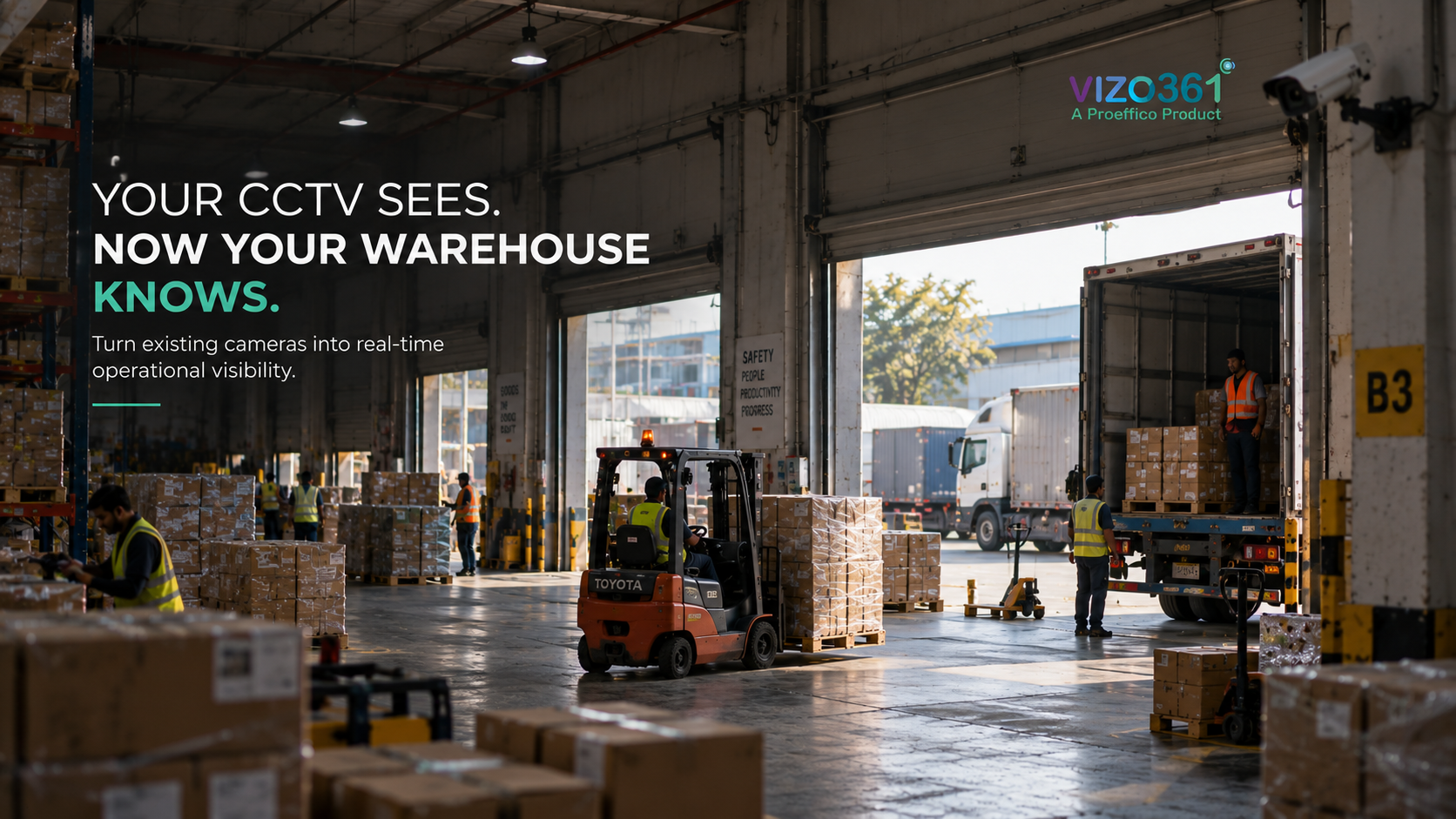
Most warehouses in India already have thirty, fifty, sometimes a hundred-plus cameras running. Almost none of that footage is watched live, and almost all of it exists only to be pulled up after something has already gone wrong. AI CCTV analytics for warehouses changes that math — the same cameras start flagging the shrinkage, the dock delays and the safety misses while they're still happening, not after the loss is booked.
Blind spots in warehouse CCTV
A warehouse camera system was built for a different job than the one it's being asked to do now. It was set up to record, store for 30 or 60 days, and get pulled up when a pallet goes missing or a forklift clips a rack. That works fine for investigation. It does nothing for prevention.
The real blind spots aren't in the camera coverage — they're in the attention. A control room with a dozen screens and one guard on a 12-hour shift is not watching the loading bay, the high-value SKU cage, and the racking aisle at the same time, every minute. Nobody can. So the things that matter most — a truck idling too long at a dock, a picker walking into a restricted forklift lane, stock moving out through a side exit that isn't on the manifest — happen in full view of a camera and get noticed by exactly no one until the shift-end reconciliation, or worse, the monthly stock count.
That's the gap AI CCTV analytics for warehouses is built to close: it doesn't replace the cameras, it gives them a job description.
What AI analytics tracks in a warehouse
On top of existing camera feeds, AI video analytics runs continuous, rule-based detection across zones you define — not blanket surveillance, but specific triggers tied to specific risks. In a typical warehouse deployment, that includes:
- Restricted-zone entry — alerts when a person enters a forklift-only lane, a high-value cage, or a racking zone without authorization
- Loitering and unusual dwell time — someone standing near a stacked pallet or exit door longer than a set threshold
- Intrusion after hours — motion or entry detected in the warehouse when it should be empty
- Fire and smoke detection — early visual detection in storage zones, ahead of thermal sensor triggers in many layouts
- People counting and footfall — how many people are in a zone at a given time, useful for both safety headcounts and shift audits
- PPE and safety compliance — flags where helmets or vests are mandated but not worn in a zone
None of this needs new cameras. It runs as a layer on the CCTV that's already mounted, which is the whole point — a warehouse operator isn't signing up for a rip-and-replace project, just for the existing feed to start doing something useful in real time.
The alerts land as notifications — app, dashboard, or WhatsApp depending on setup — routed to whoever is actually responsible for that zone, not just logged into an archive nobody opens until there's a reason to.
Loading-bay and dock monitoring
The loading bay is usually where a warehouse loses the most time and the most inventory, and it's the zone least likely to be watched carefully, because everyone assumes the paperwork covers it.
AI CCTV analytics adds visibility that paperwork can't:
- Dwell-time tracking on dock doors — how long a truck actually sat at the bay versus what the gate log says, which matters when detention charges or driver turnaround SLAs are in play
- ANPR at the gate — automatic number-plate capture logs every vehicle in and out with a timestamp, cross-checkable against the gate pass or e-way bill without a guard manually noting plates in a register
- Loading/unloading activity detection — flags when a truck is at the dock with no loading activity happening, which is often the first sign of a delay worth investigating rather than discovering at month-end
- Unauthorized dock access — alerts if a vehicle or person is at a bay door outside its scheduled slot
For warehouses running multiple dock doors and tight turnaround targets — common across 3PL and distribution operations — this is less about catching bad actors and more about getting an honest, timestamped record of what actually happens at the gate versus what gets written down. For a closer look at how number-plate capture works and where it pays off beyond the warehouse gate, see ANPR (Number Plate Recognition) in India.
Shrinkage and loss control
Shrinkage in a warehouse rarely happens in one dramatic event — it's usually a slow leak: a case that "fell," a pallet that got short-picked and nobody flagged it, stock that moved through a door that isn't on the standard flow. By the time a physical count catches it, there's no footage left to review and no way to pin down when or how.
AI analytics changes the timeline. Instead of discovering a variance at the next cycle count, a warehouse gets flagged in near-real time when:
- Stock movement happens at a zone or time outside the expected pattern (e.g., activity in a storage aisle after the last shift has clocked out)
- A person enters a high-value cage without a matching access log
- An exit door is used that isn't part of the standard dispatch route
This doesn't replace inventory reconciliation or a proper cycle-count discipline — it gives the loss-prevention and warehouse ops team a much shorter list of moments to actually go review, instead of scrubbing 60 days of footage after a count comes up short. The honest version for now is that the value is in cutting investigation time and catching the pattern early, not eliminating shrinkage outright.
Getting started
A warehouse doesn't need to analytics-enable every camera on day one. The deployments that go well tend to follow a similar shape:
- Start with the zones that already hurt — the loading bay, the high-value SKU area, the main exit. Not the whole facility.
- Confirm camera angle and coverage before assuming analytics will work — a camera mounted for general area coverage may need repositioning for reliable zone detection or plate capture.
- Set alert routing before go-live — decide who gets a restricted-zone alert on their phone and what they're supposed to do with it. An alert nobody acts on is just more noise.
- Pilot for 2–4 weeks, then expand to more zones or docks based on what actually triggered and what didn't.
- Review false positives early — thresholds (dwell time, loitering duration, zone boundaries) usually need one or two rounds of tuning to match how the warehouse actually operates.
VIZO361 runs this as a layer on existing CCTV — no forklift-mounted sensors, no new camera runs, no rip-and-replace. If the warehouse already has IP cameras with a usable feed, that's the starting point.
Frequently Asked Questions
Does AI CCTV analytics work with our existing cameras, or do we need new ones?
In most cases, existing IP cameras work if they have adequate resolution and the right mounting angle for the zone being monitored. Very old analog-only systems or cameras placed for general coverage rather than zone-specific monitoring may need repositioning or an upgrade for reliable detection — this gets confirmed during a site assessment rather than assumed.
How is this different from a regular CCTV recording system?
A standard CCTV system records and stores footage for after-the-fact review. AI analytics adds a live detection layer on top — it watches the feed continuously against rules you set (restricted zones, dwell time, PPE, plate capture) and sends alerts when something breaks a rule, instead of waiting for someone to go looking.
Can this replace our security guards or warehouse supervisors?
No — it's built to support them, not replace the role. It filters hours of footage down to the specific moments that need a human decision, so the existing team spends less time watching screens and more time acting on what actually matters.
How accurate is ANPR at a warehouse gate compared to manual logging?
Automated plate capture removes the transcription errors and gaps that come with a guard manually noting plates in a register, and it timestamps every entry/exit automatically. Accuracy depends on lighting, plate condition, and camera angle at the gate — these are checked and tuned during setup rather than assumed to work out of the box.
What's a realistic timeline to get this running in one warehouse?
A focused pilot on two or three zones (loading bay, one storage area, main exit) typically takes a few weeks from camera/angle assessment to alerts going live, followed by a tuning period as thresholds get adjusted to the warehouse's actual operating pattern.
If shrinkage, dock delays or unmonitored zones are costing your warehouse more than you can currently prove, Book a demo - see it on your cameras.