Most Indian retail stores can tell you exactly how much they sold yesterday, down to the rupee. Very few can tell you how many people actually walked in. That gap — knowing revenue but not footfall — is why a people counting system retail India stores install almost always pays for itself faster than any other camera-based upgrade. This guide walks through how it works, what it changes on the floor, and how to choose one without overbuying hardware you don't need.
Why footfall is your most ignored metric
Ask a store manager for last month's sales and they'll pull it up in seconds. Ask how many shoppers walked past the entrance and most will guess. That's a problem, because footfall is the denominator behind almost every retail number that matters.
Without it, a store can't answer basic questions:
- Is a slow week a demand problem or a conversion problem?
- Did last week's window display actually pull in more walk-ins, or did the same people just stay longer?
- Are Saturday staffing levels matched to Saturday traffic, or just copied from last month's roster?
Sales data alone can't answer any of these. A billing system only counts people who bought something — it has nothing to say about the much larger number who walked in, browsed, and left. In a category where conversion rates for apparel, footwear and general retail commonly sit in the low double digits, that means the majority of your store traffic is invisible in every report you currently run. Footfall is the metric that turns "sales were flat" into "traffic was flat" or "traffic was up but conversion dropped" — two very different problems with very different fixes.
How people counting works on existing cameras
The traditional pitch for a people-counting system meant a dedicated sensor mounted over every entrance — a separate box, separate wiring, separate installer, separate AMC. That's still how a lot of vendors sell it in India, and it's a big part of why footfall tracking never made it past a handful of premium stores.
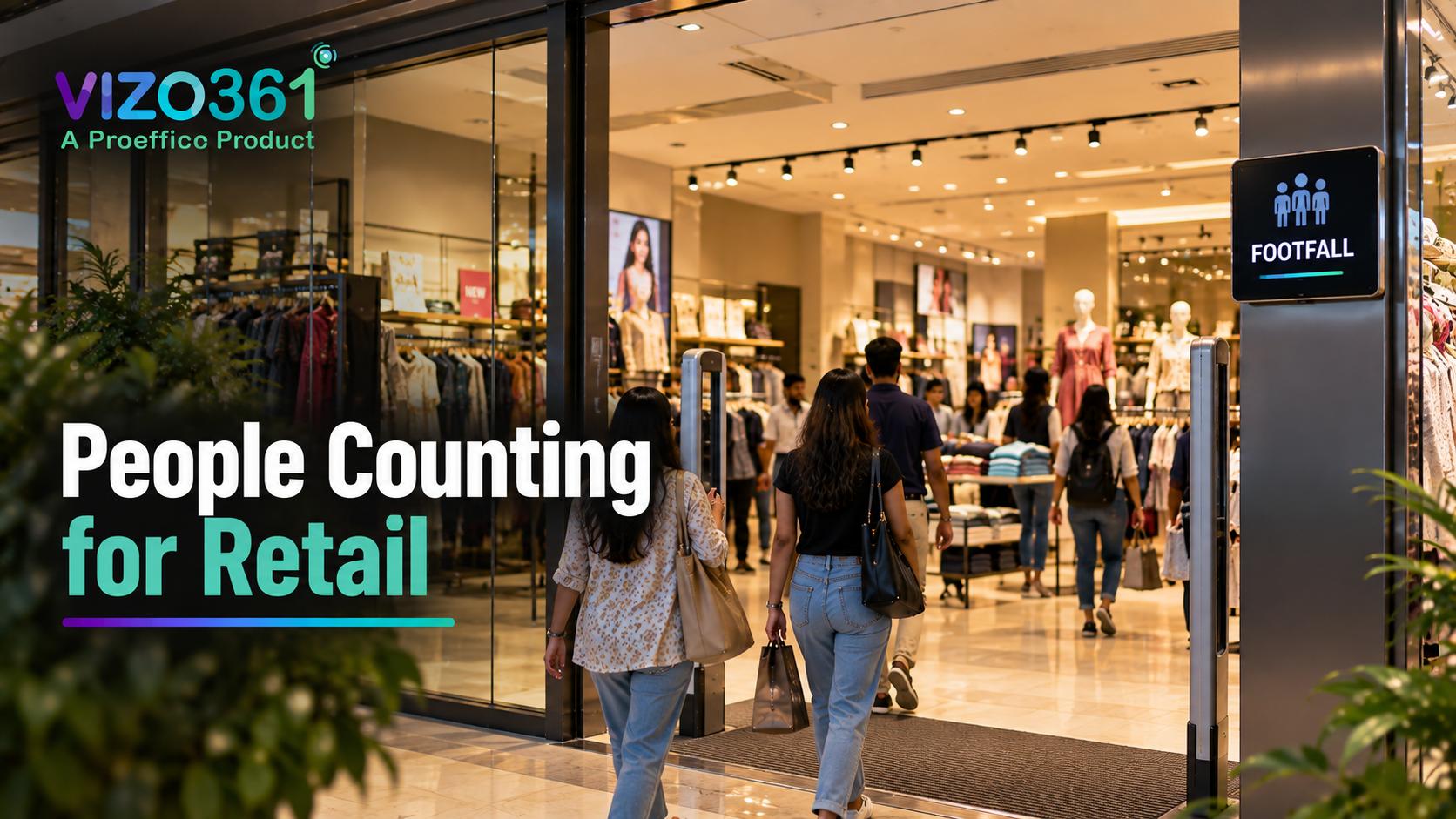
VIZO361's approach is different: the Footfall module runs as AI analytics on the CCTV cameras a store already has at its entrance and aisles. There's no new hardware to mount and no rip-and-replace of an existing surveillance investment — the same camera that's been watching your entrance for security now also counts, in real time, everyone crossing that line, in and out, separately.
That distinction matters for two practical reasons:
- Cost and disruption. Adding a counting layer on top of existing DVR/NVR infrastructure is a software rollout, not a hardware project — no fresh cabling, no additional mounting points, no downtime while an electrician works on the ceiling.
- Multi-location rollout. A retail chain with stores across formats and camera vendors doesn't need to standardize on one sensor brand before it can start counting. If the cameras are IP-based and positioned to cover the entrance, the module can be turned on store by store.
The output is a live, store-wise footfall number that sits alongside — not instead of — your POS data, so the two can finally be compared on the same dashboard.
Conversion, peak hours and staffing
Footfall by itself is a curiosity. Footfall next to sales is a decision-making tool. Once a store has both numbers for the same time window, three things become possible that weren't before:
Real conversion tracking. Divide transactions by footfall for any hour, day or campaign period and you get an actual conversion rate — not an industry benchmark, your store's own number. A store running a discount weekend can now see whether the offer pulled more people in, converted more of the people already walking past, or did neither.
Peak-hour staffing that matches real traffic. Most stores roster staff on a fixed weekly pattern built from memory and habit. Hourly footfall data usually shows peaks that don't line up neatly with that pattern — a lunch-hour spike near office clusters, a weekend evening surge in malls, a Sunday-morning lull that's being over-staffed out of caution. Matching shifts to the actual curve, rather than the assumed one, is one of the more immediate ways stores use this data without touching marketing spend at all.
Campaign and layout accountability. When a new window display goes up, or a category gets moved closer to the entrance, footfall and dwell patterns (paired with VIZO361's heatmap analytics — see our guide on retail heatmap analytics) show whether it actually changed shopper behaviour, instead of relying on a manager's gut feel two weeks later.
None of this requires a data science team. It requires the two numbers — footfall and sales — living in the same view, updated daily, for someone on the floor or at head office to glance at.
Privacy-conscious setup
Footfall counting only needs to know that a person crossed a line — not who that person is. It's a fundamentally different, and much lighter, kind of analytics than facial recognition, and it's worth being explicit about that difference with staff and, where relevant, customers.
A few things that matter in an Indian retail context:
- No identity is stored. The Footfall module counts crossings; it doesn't build a profile of an individual shopper or retain a face template. That keeps it well clear of the privacy concerns that come with identity-based modules.
- Camera placement should be entrance/aisle-focused, not changing-room-adjacent. Basic placement discipline — counting at doorways and walkways, not near trial rooms — avoids most sensitivity issues before they start.
- Staff should know what's being measured. A short internal note explaining that the system counts traffic, not identity, heads off the "are we being watched" conversation before it becomes one.
- ISO 27001-aligned data handling on the platform side means footfall data is stored and processed under the same information-security discipline as VIZO361's other modules — relevant if a retail chain's IT or compliance team asks how the data is handled, which they increasingly do.
For a chain operating across states with different customer sensitivities, this lighter-touch approach to footfall (versus, say, a facial-recognition-based loyalty system) tends to be an easier internal approval to get.
How to choose
Not every people-counting claim in the market means the same thing, and a few questions separate a genuinely useful system from a line-item that never gets looked at again:
- Does it work on your existing cameras, or does it require new sensors at every door? This is the single biggest cost and rollout-speed difference between vendors.
- Can it separate in-counts from out-counts reliably at a busy entrance? A single combined number is far less useful than accurate directional counting, especially at malls or high-street stores with continuous two-way traffic.
- Does footfall data connect to your sales data, or sit in its own separate dashboard? A number nobody looks at because it lives in a second login is a number that won't change behaviour.
- How is multi-store data rolled up? Chain retailers need a head-office view across locations, not just a per-store screen the local manager checks occasionally.
- What's the actual accuracy in your store's conditions — entrance width, lighting, crowd density at peak hours? Ask for this specific to your format rather than a generic spec sheet number.
A store evaluating this shouldn't need a pilot that takes months. Because the module runs on existing CCTV, a short trial at one or two locations is usually enough to see whether the counts match a manual spot-check and whether the resulting reports are something the team will actually use.
Frequently Asked Questions
Does a people counting system need new cameras installed?
No, not with VIZO361. The Footfall module runs as AI analytics on the CCTV cameras already covering your entrance, provided they're IP cameras positioned to capture the doorway. There's no separate sensor hardware to mount.
How accurate is camera-based people counting compared to a dedicated sensor?
Accuracy depends heavily on entrance width, camera angle and crowd density at peak times, so it varies by store. The best way to judge it for your specific layout is a short in-store trial comparing the system's count against a manual spot-check.
Is people counting the same as facial recognition?
No. People counting only detects that a person crossed a line — it doesn't identify who that person is or store any facial data. It's a lighter-weight form of analytics than identity-based modules like VIZO361's Face Recognition (FR) module.
Can footfall data be linked to sales to measure conversion rate?
Yes — that's where most of the value comes from. Comparing footfall against POS transactions for the same period gives a store its actual conversion rate, by hour, day or campaign, rather than relying on an industry-average guess.
Does this work for a multi-store retail chain, not just a single outlet?
Yes. Because the module runs on the cameras each store already has, it can be rolled out location by location without needing to standardize hardware across the chain first, with footfall data rolling up into a single head-office view.
If your stores are already on CCTV, footfall is one of the fastest analytics upgrades to switch on — no new hardware, no rip-and-replace, just a number you've been missing on the same screen as your sales. Book a demo - see it on your cameras and VIZO361 will show you what your own entrance traffic looks like.