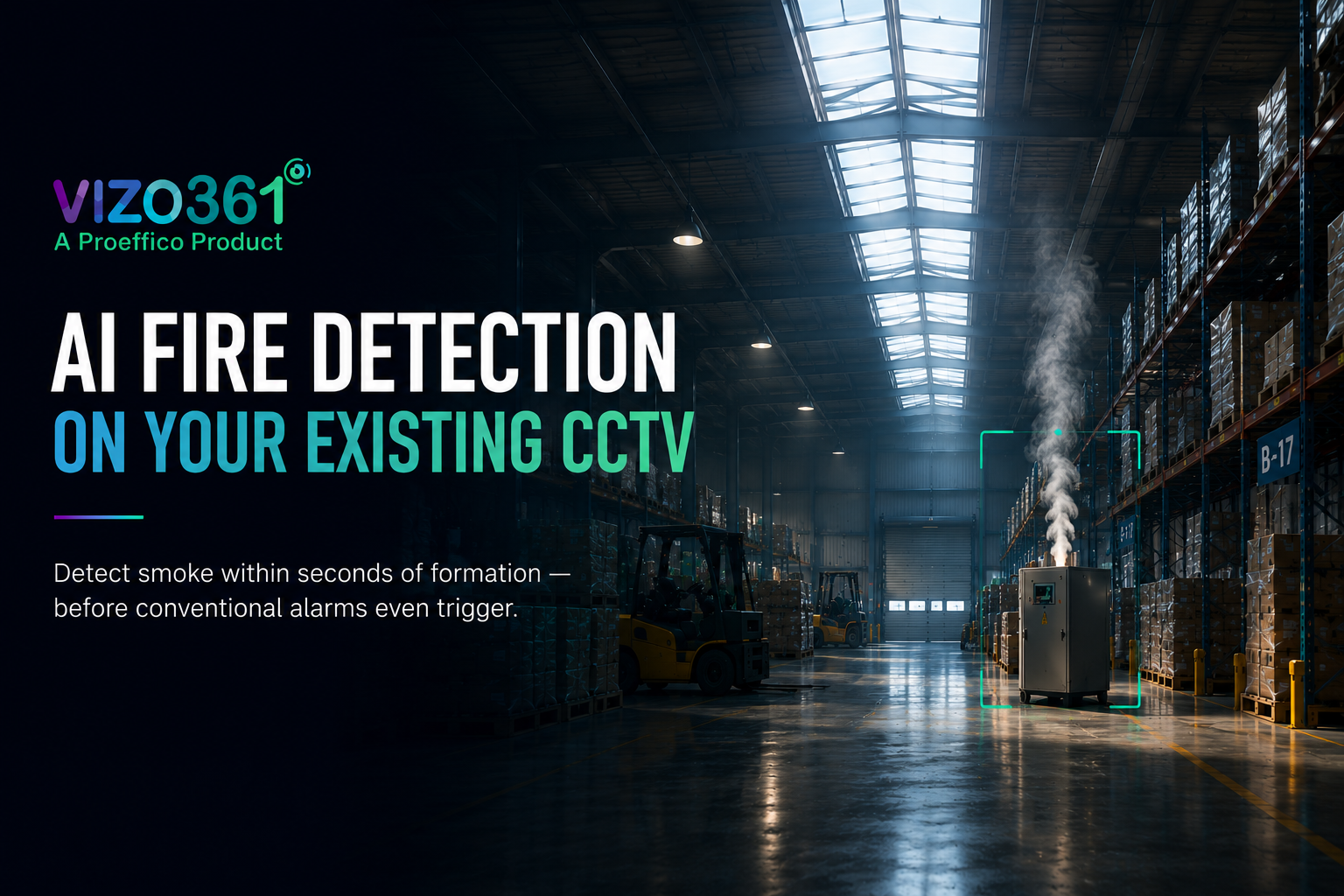
A fire in a large warehouse or factory bay can burn for two to five minutes before the ceiling-mounted detector registers it. The smoke disperses. The heat hasn't climbed high enough yet. Everything looks fine on the panel — and then it isn't. AI fire detection on CCTV is designed specifically for that window: the time between first visible smoke and the moment a conventional alarm finally sounds.
This post explains how the technology works, where it earns its place, and what to check before you deploy it — including where it has genuine limits.
Why conventional fire alarms are the last line of defence, not the first
Conventional heat detectors work by sensing a rise in air temperature at the device itself. In an enclosed office, that's fine — the room is small and the air is relatively contained. On a 10,000-square-metre factory floor, a loading dock, or a covered outdoor area, the physics don't cooperate. Smoke rises, diffuses, and loses concentration long before it reaches a sensor mounted six or eight metres above the source.
Ceiling-mounted photoelectric smoke detectors are more sensitive than heat detectors, but they share the same geometric problem in large open spaces. The time between ignition and alarm isn't instant — it depends entirely on how quickly enough smoke reaches the sensor's chamber. In factory bays and warehouses, that delay is real and measurable.
The result: by the time a conventional alarm triggers, a fire in an open industrial space has typically had minutes to grow. That's time your materials, your assets, and — more importantly — your people can't afford.
Camera-based detection closes that gap because it watches the floor area where ignition actually starts, not the air near the ceiling. The moment smoke forms visually, it's detectable — before heat has built, before air currents have dispersed the smoke, and before anything on the control panel has moved.
How AI fire and smoke detection works on a camera feed
The core of camera-based fire detection is a computer vision model trained on a large dataset of smoke and flame patterns — different materials burning, different lighting conditions, different smoke densities, different environments. What the model learns to recognise is not "fire" as a general concept but the specific visual signature of early-stage smoke: the way it drifts, its texture, how its edges diffuse compared to steam or dust.
VIZO361's fire-watch detection agent runs on your existing IP or analog cameras. No new sensors, no new wiring. The agent connects over RTSP/ONVIF — the standard protocols most commercial IP cameras already support — and processes the stream in real time. Detection covers three distinct stages:
- Pre-flame smoke — the earliest visual indicator, often before any heat signature is detectable
- Active flame — bright, flickering, fast-moving patterns distinguishable from other light sources
- Smouldering smoke — slower, denser, typical of electrical fires or material burning at low oxygen levels
The false-alarm challenge in industrial environments is real. Foundries produce steam and metallic dust. Kitchens generate cooking vapour. Covered loading areas collect dust clouds when vehicles move. A model that flags all of these as smoke events will get switched off inside a week. VIZO361's fire-watch agent is trained specifically on these visual lookalikes — steam behaves differently to smoke in terms of density progression and edge definition — to keep false-positive rates at a level operations teams can work with.
When a detection event triggers, a timestamped alert with a short video clip goes to the duty safety officer's phone, a PA system, or your building management system (BMS) — not just to a wall-mounted control panel that may or may not have someone watching it.
Where it is most effective — and where it has limits
AI fire detection on cameras performs best in environments where conventional detectors struggle most:
- Large open factory floors and warehouse bays — exactly where ceiling-mounted detectors face the greatest geometric disadvantage
- Vehicle maintenance bays — fuel, oil, and electrical ignition risks in a wide-floor space with poor vertical airflow
- Covered outdoor loading docks — partially open structures where smoke dissipates before reaching any ceiling sensor
- Data centres with raised floors — where sub-floor cable fires can smoulder for minutes before surface-level detectors respond
- High false-alarm environments — industrial kitchens, foundries, and cement production areas where conventional detectors trigger constantly and get desensitised
The hard limit is straightforward: if no camera covers the area where ignition starts, the system cannot detect it. Camera placement is the single most important variable in any deployment. A fire-watch installation without a camera coverage audit first is not a complete deployment. The question isn't "do we have cameras?" — it's "do our cameras cover the floor area at an angle that would show early smoke in the zones where fire risk is highest?"
One more honest point: AI fire detection is an early-warning layer, not a fire suppression system. It identifies the event faster so your team can respond sooner and your existing suppression systems can activate with more time to work. It complements sprinkler systems, fire extinguishers, and evacuation procedures — it doesn't substitute for them.
Works on the cameras already pointed at your risk zones
The differentiator that makes camera-based fire detection practically deployable in most existing facilities — rather than requiring a full sensor overhaul — is protocol compatibility. VIZO361's fire-watch agent connects via RTSP/ONVIF, which covers the overwhelming majority of commercial IP cameras currently installed in Indian industrial and commercial facilities. If you have a camera covering a high-risk zone, that camera is already the sensor. What changes is what watches it.
Processing can be configured two ways depending on your requirements. Edge processing keeps everything on-site: near-zero latency, no dependency on internet connectivity, and your video data never leaves the facility — relevant for environments with data-residency requirements or where even a few seconds of cloud round-trip is too slow. Cloud processing enables multi-site monitoring from a central safety dashboard, which is particularly useful for facility operators managing several locations under one security team.
The platform is ISO 27001-backed. For India deployments, VIZO361 provides guidance on STQC/BIS-ER compliant IP camera use — relevant for facilities that need to demonstrate compliance-aligned surveillance infrastructure. Alert routing integrates with a supervisor's phone, PA systems, hooters, or existing BMS — so the detection event reaches whoever needs to act on it, not just a box on the wall.
For factory and industrial deployments specifically, fire-watch pairs naturally with PPE compliance monitoring for factory safety — building a broader safety intelligence layer on the same camera infrastructure. Learn more about what the full platform does across industrial environments in our overview of VIZO361 for manufacturing and industrial sites.
Three questions to scope a deployment
Before bringing a vendor in for a demonstration, it's worth working through three questions internally. The answers shape everything from camera placement decisions to alert routing to whether edge or cloud processing is the right fit.
- Which zones carry the highest fire risk — and do your cameras currently cover the floor area in those zones? A camera pointed at a doorway doesn't cover a storage racking area fifteen metres behind it. Map fire risk against camera coverage angles before evaluating the technology.
- What is your target response time — and who needs to receive the alert? An alert that reaches a control room with no one in it at 2 AM is not the same as an alert that goes directly to the on-call safety officer's phone. Define the response chain before deployment, not after.
- Is this a complement to your existing detectors or a primary early-warning layer in spaces where detectors are inadequate? The answer changes the business case. In an enclosed office building, AI camera detection adds a layer on top of already-adequate conventional alarms. In a 15,000-square-metre logistics facility, it may be the only detection system with any practical chance of catching a floor-level ignition event before it grows.
If the answer to question three is "primary early-warning layer," the camera coverage audit becomes non-negotiable before any other step.
Frequently Asked Questions
How much earlier can AI fire detection on CCTV catch smoke compared to a conventional alarm?
The timing advantage comes from the physics of large open spaces. Conventional ceiling-mounted heat detectors and photoelectric smoke detectors require smoke or heat to rise and reach the sensor — in a factory bay or warehouse, that can take several minutes after ignition. Camera-based detection watches the floor area where fires start, so it can identify the first visual smoke before heat has built or smoke has dispersed.
Does AI fire detection work in environments with steam, welding fumes, or heavy dust?
This is the critical operational question for Indian industrial sites. VIZO361's fire-watch agent is trained to distinguish combustion smoke from visual lookalikes — steam behaves differently to smoke in terms of density progression and edge definition, and the model is specifically calibrated for foundry, welding, and dusty production environments. A false-alarm rate that causes the system to be muted by week two defeats the purpose of the deployment.
Does AI fire detection replace conventional smoke and heat alarms, or complement them?
It complements them — it does not replace them. AI fire detection on CCTV is an early-warning layer that identifies smoke visually, faster than ceiling-mounted sensors in large open spaces. Conventional alarms, sprinkler systems, and evacuation procedures remain in place. The value of the AI layer is in closing the gap between when a fire starts and when your team can respond, giving suppression systems and evacuation procedures more time to work.
What types of locations benefit most from AI fire detection on existing cameras?
The environments where AI detection has the clearest advantage over conventional alarms are large open factory floors, warehouse bays, vehicle maintenance bays, covered outdoor loading docks, and data centres with raised floors. These are precisely the spaces where ceiling-mounted detectors face the greatest geometric disadvantage — smoke rises and disperses before reaching the sensor. In enclosed offices with low ceilings, conventional detectors already work well and the case for AI detection is less compelling.
Does AI fire detection on CCTV work on the cameras already installed in my facility?
VIZO361's fire-watch agent connects via RTSP/ONVIF, which covers the overwhelming majority of commercial IP cameras currently installed in Indian industrial and commercial facilities. If you have a camera covering a high-risk zone, that camera is already the sensor. The critical variable is not camera brand — it is whether the camera is actually aimed at the floor area where fire risk is highest, not at a doorway or perimeter. A camera coverage audit is the first step in any fire-watch deployment.
The bottom line
Conventional fire alarms are engineered for enclosed spaces. Large open industrial environments — factories, warehouses, vehicle bays, covered docks — weren't what those sensor designs had in mind. AI fire detection on CCTV was. It watches the floor where fires start, not the ceiling where smoke eventually arrives, and it does it on the cameras already installed.
The gap between "fire starts" and "alarm sounds" is where damage happens. Closing it doesn't require new sensors, new wiring, or a rip-and-replace of your camera infrastructure. It requires the right software connected to the cameras already covering your risk zones — and the honest answer to whether those cameras are actually pointed where they need to be.
To understand how VIZO361's fire-watch detection agent fits your specific site layout, or to see how video analytics surveillance turns cameras into action across your full facility, the fastest way is a demo with your camera map in hand. For organisations evaluating AI safety tools as part of a broader operational intelligence programme, Proeffico's manufacturing AI solutions cover fire-watch alongside the wider suite — and Proeffico's enterprise security AI spans all the risk scenarios worth addressing at once.
Bring your site layout and camera map. We'll tell you in the first conversation whether coverage is adequate — or where the gaps are. Book a VIZO361 fire-watch demo.