AI PPE & Safety Compliance Detection on Existing CCTV (2026 Guide)
PPE — personal protective equipment — is the last line of defence on a factory floor, a warehouse, or a construction site: helmets, hi-vis vests, gloves, harnesses, safety goggles. It only works if it's actually worn, at the moment it matters, by every person in the zone where it matters. Most sites already know this, which is why they run safety walkarounds and periodic audits. What they usually don't have is a way to know, in real time, that someone just walked past a moving conveyor without a hard hat, or climbed scaffolding without a harness. That's the gap PPE detection AI camera systems are built to close — using the CCTV (closed-circuit television) cameras a site already has, watching continuously for the specific safety gaps that a walkaround can't catch in the moment they happen.
This guide covers what manual safety monitoring actually costs a site, how AI PPE and safety compliance detection works technically, what it typically catches, how real-time alerting differs from periodic audits, and how to think about privacy when cameras are also watching your workforce.
The cost of manual safety monitoring
Most manufacturing plants, warehouses, and construction sites rely on a mix of safety officer walkarounds, supervisor spot-checks, and scheduled audits to enforce PPE compliance. It's a reasonable starting point, but it has a structural weakness: a safety officer can only be in one place at a time, and a shift can run eight, ten, twelve hours across a floor with dozens of active zones.
The result is coverage that's thin by design. A walkaround happens once every few hours, if that. Between checks, compliance drifts — a worker takes off gloves to handle a phone, someone skips the vest for a "quick" trip across the yard, a contractor unfamiliar with site rules walks a restricted zone without the right gear. None of this shows up until either a safety officer happens to be looking, or worse, until there's an incident and the investigation reveals the gap was there for weeks.
Audits compound the problem. A monthly or quarterly safety audit is useful for documentation and compliance reporting, but it's a snapshot, not a control. It tells you whether the site was compliant on the day someone counted — not whether a machine operator was working bare-handed next to a grinder every other Tuesday. For a facility with a genuine safety record to protect, that's not enough, and it's the reason interest in camera-based safety compliance detection has grown alongside interest in AI video analytics for theft and fire risk — the underlying problem is the same: you can't manage what you're only checking a few times a day.
How AI detects PPE gaps
AI-based PPE detection runs a computer-vision model on the live feed from cameras already installed on site — at entry points, near machinery, on the factory floor, at height-work zones — and looks for people, then classifies whether the required protective gear is present and worn correctly on each person it sees.
Technically, this happens in two steps. First, the system detects and tracks people in the frame, distinguishing individuals even in crowded or moving scenes. Second, for each detected person, it checks for the specific PPE items relevant to that zone — a helmet on the head (not carried, not absent), a vest visible on the torso, gloves on hands near a hazard point, a harness connected before someone works at height. Because different zones carry different risks, the rules are usually configured per zone: a warehouse aisle might only require a hi-vis vest, while a welding bay requires goggles and gloves, and a scaffold zone requires a harness check specifically.
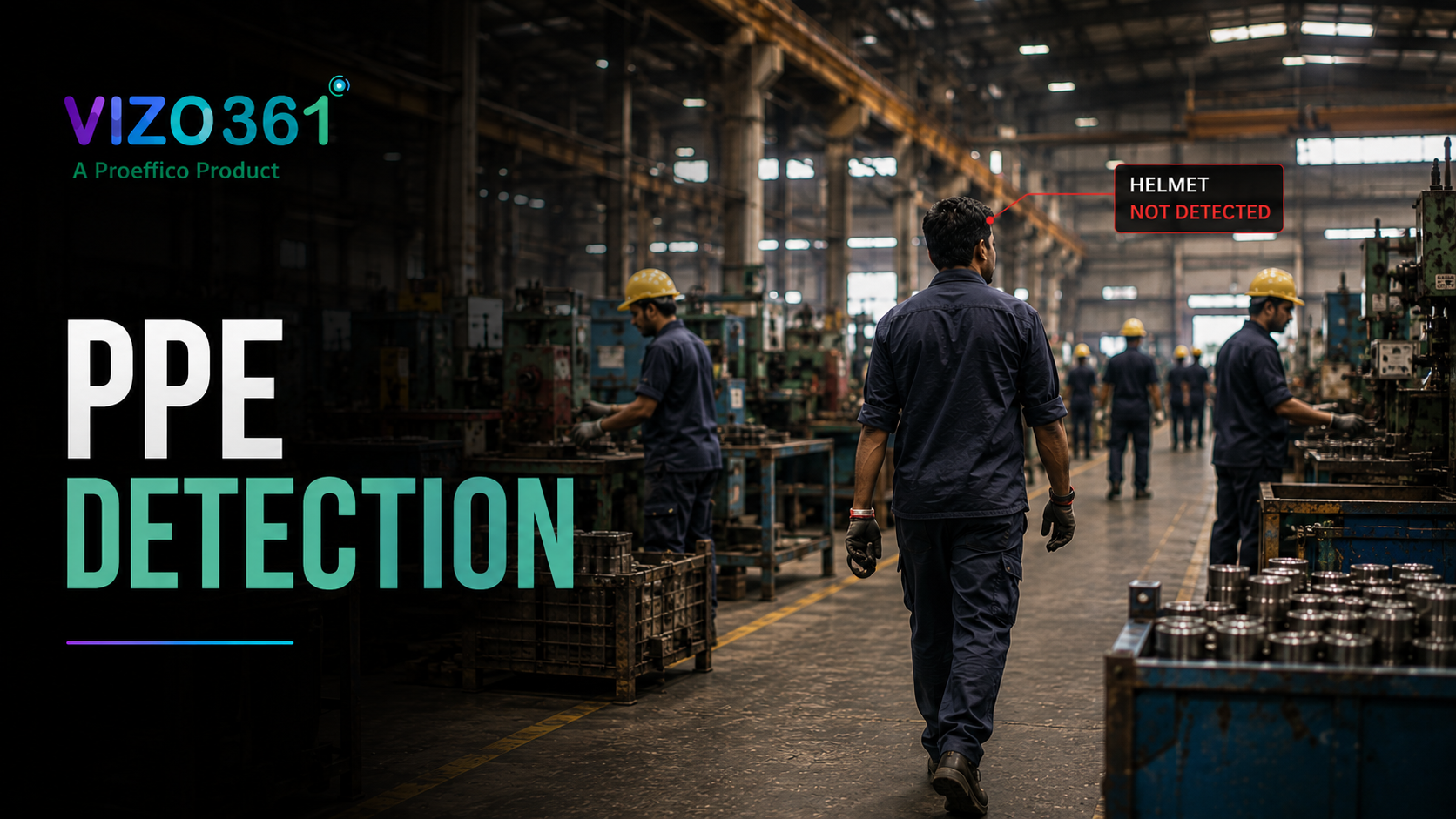
When the model detects a gap — no helmet, an unworn vest, gloves missing at a machine interface — it doesn't just log it silently. It generates an alert with a timestamped clip, so a supervisor sees exactly who, where, and what was missing, without needing to review hours of footage after the fact. This is the same core detection approach VIZO361 uses for cash-counter theft or restricted-zone breaches — a model trained on a specific behaviour or condition, watching continuously rather than being watched occasionally.
Common detections
Not every site needs every check running everywhere. In practice, the detections that come up most often across manufacturing, warehousing, logistics, and construction sites are:
- Helmet and hard-hat detection — flags a person in a designated zone without head protection, or wearing it incorrectly (unfastened, pushed back).
- Hi-vis vest detection — common at loading docks, yards, and any area with moving vehicles or forklifts, where visibility is the actual safety mechanism.
- Harness and fall-protection checks — for work at height, confirming a harness is worn and, where the setup supports it, connected before someone steps onto scaffolding or a platform.
- Glove detection near machinery — bare-hand detection at points where a machine interface, sharp edge, or chemical handling point makes gloves mandatory.
- Mask or respiratory protection — relevant in dusty, fume-heavy, or cleanroom-adjacent environments.
- Restricted-zone breach with missing PPE — combining two checks at once: is a person in a zone they shouldn't be without authorisation, and are they wearing what that zone requires.
Sites typically start with one or two of these — usually helmet and vest detection, since those cover the broadest set of incidents — and expand the module set as the initial deployment proves out.
Real-time alerts vs audits
The practical difference between AI PPE detection and a traditional audit is timing, and timing is the whole point of safety monitoring. An audit tells you, after the fact, that a gap existed. Real-time alerting tells a supervisor while it's still happening, so the correction — put the helmet back on, step out of the zone, connect the harness — happens before an incident, not after one.
This changes what safety monitoring is actually for. Audits remain useful for compliance documentation, trend reporting, and satisfying external certifications — they answer "were we compliant, broadly, over this period." Real-time detection answers a different, more urgent question: "is someone unsafe right now, in this zone, and does a supervisor know." Sites that run both tend to see the audit numbers improve on their own, because real-time correction changes behaviour day to day rather than only around the days an audit is scheduled.
It's also worth being honest about what this doesn't replace. AI detection flags what a camera can see — it won't catch every gap in poor lighting, an obstructed angle, or PPE items too small or fast-moving to classify reliably at distance. It's a layer that catches far more, far faster, than periodic human checks alone — not a substitute for a trained safety officer or a site's existing safety culture.
Privacy-conscious design
Putting AI on cameras that watch a workforce raises a fair question: is this about safety, or is it surveillance of employees. The honest answer depends entirely on how the system is configured and communicated.
A well-designed PPE compliance deployment is scoped narrowly — it's checking for the presence of specific safety equipment in specific zones, not building a profile of who someone is or tracking their movement across the site for reasons unrelated to safety. Where facial recognition (FR) isn't needed for the use case, it shouldn't be turned on; PPE detection works on classifying gear, not identifying individuals, unless a site specifically wants alerts tied to a named worker for coaching or repeat-violation tracking.
Sites rolling this out responsibly generally do three things: communicate to the workforce what's being monitored and why, before deployment, not after; limit data retention on non-incident footage to what's actually needed for safety records; and confirm with the vendor how detection data and clips are stored and who can access them. VIZO361 is built on ISO 27001-aligned data-handling practices, and the same "existing cameras, no new hardware" approach that keeps rollout fast also means the conversation with a workforce is usually easier — it's a software layer on cameras already on site, not a new surveillance system being installed.
For manufacturing floors already running AI-driven operational monitoring — the kind of real-time incident flagging Proeffico has built for factory clients moving off manual paperwork and reactive reporting — PPE detection is often a natural next module on top of infrastructure that's already there, covered further in Proeffico's broader work on AI-driven factory intelligence. It also sits alongside VIZO361's other safety modules, including camera-based fire and smoke detection and restricted-zone access control via ANPR, on the same camera network.
Frequently Asked Questions
What is PPE detection AI camera technology, in plain English?
It's software that watches your existing CCTV feed and automatically checks whether people in a zone are wearing the required safety gear — a helmet, vest, gloves, harness — flagging a supervisor the moment someone isn't, instead of relying on a person to notice during a walkaround.
Do we need new cameras for PPE and safety compliance detection?
Usually not. Like VIZO361's other modules, PPE detection is designed to run on existing CCTV, provided the cameras have a clear enough view and resolution of the zone being monitored — no rip-and-replace hardware project required.
How accurate is helmet and vest detection in real industrial environments?
Accuracy depends on camera angle, lighting, distance, and occlusion (people or equipment blocking the view), which is why any serious evaluation should be tested on your actual site footage rather than a demo reel.
Does this replace our safety officers or audits?
No. It's a continuous layer that catches gaps between checks and gets a correction made faster — it doesn't replace the judgment of a trained safety officer, and audits still matter for compliance documentation and trend reporting.
Is this a privacy concern for our workforce?
It can be, if it's deployed as broad surveillance without communication. Scoped correctly, PPE detection classifies safety gear, not identity, and doesn't need facial recognition switched on unless a site specifically wants violations tied to a named individual. Communicating what's monitored, and why, before rollout matters.
Manual safety monitoring catches what a person happens to see, when they happen to be looking. AI PPE and safety-compliance detection watches every zone, every shift, and flags the gap before it becomes an incident report. Book a demo - see it on your cameras.