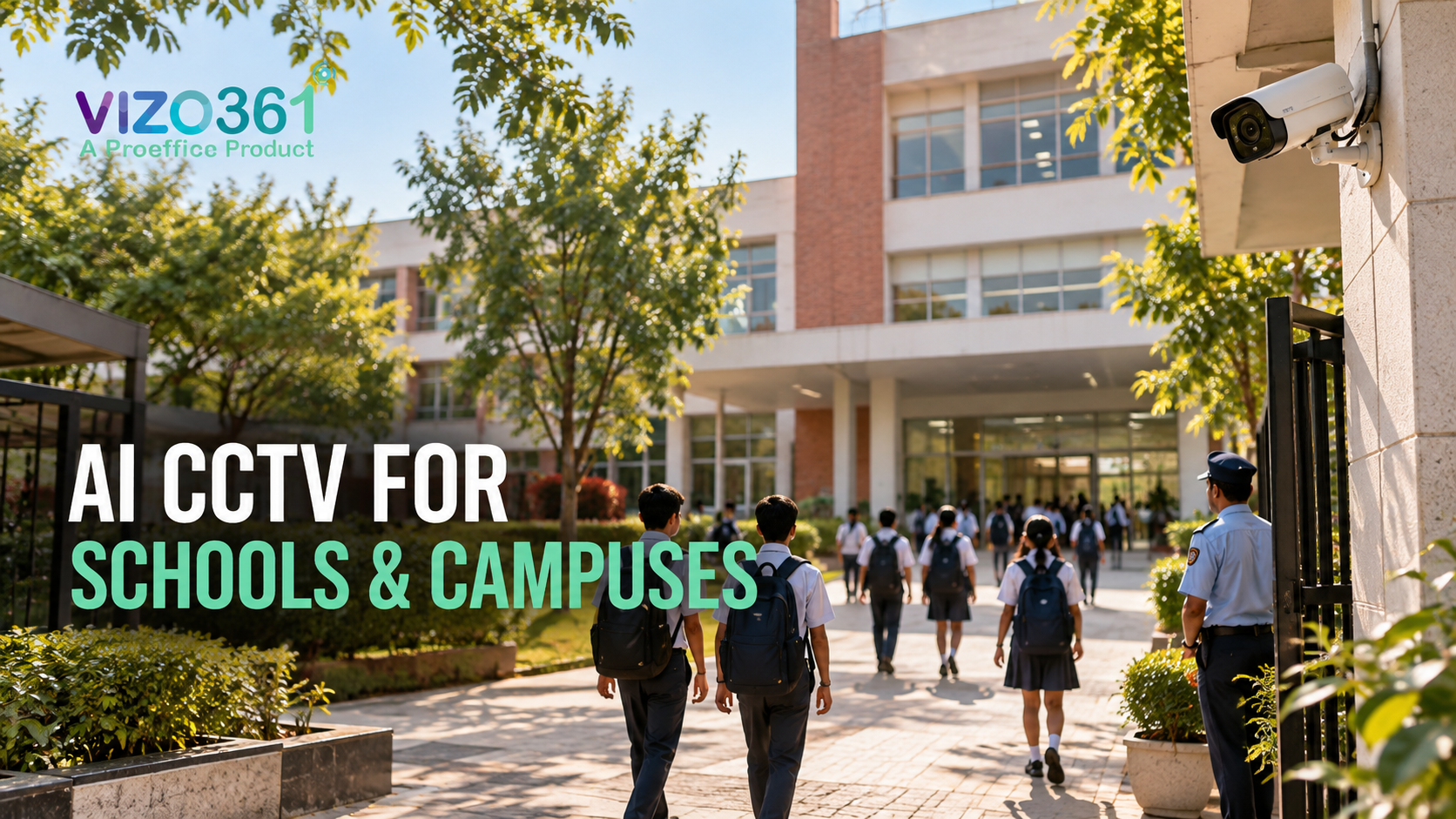
# AI CCTV for Schools & Campuses: A Practical Safety Guide (2026) Most school and college campuses already have cameras at the main gate, along the boundary wall, in corridors, and near the parking area. What they usually don't have is anyone watching all of those feeds at once. A security guard at the gate can't also be watching the back boundary wall at 7 p.m. after the last bus leaves, and a principal reviewing footage after an incident is, by definition, too late to prevent it. **AI CCTV for schools** is built around that specific gap — it doesn't add more cameras, it makes the ones already installed capable of raising a flag the moment something worth acting on happens, instead of just recording it for later. This guide is written for the people who actually decide on campus safety infrastructure — administrators, facility heads, and trustees — and it's deliberately practical: what the real safety problems on a campus look like, how AI video analytics changes the response time, what to actually check before buying, and where the honest limits are. ## The Safety Problems Standard School Security Cameras Don't Solve A typical campus CCTV setup is a recording system, not a monitoring system. Cameras run 24/7, footage is stored for a set retention window, and someone pulls it up only after a complaint or an incident. That model works fine for after-the-fact review. It does nothing for the situations where minutes matter: - **After-hours intrusion.** School boundaries are large, often bordered by open land or under-lit stretches, and most incidents of theft, vandalism, or trespassing happen after the last class or during holidays, when the security staff on duty is thinnest. - **Unauthorized access at gates and entry points.** A visitor walking past the reception desk without signing in, a vehicle entering through a service gate that isn't meant for general access, or someone re-entering through an exit door that should stay locked — these are common and usually go unnoticed until a parent or staff member happens to see it. - **Crowd and exit-route risk at assembly and dismissal.** School gates and assembly points see dense, fast-moving crowds twice a day — pickup and drop-off — plus assemblies, sports days, and annual functions. A blocked exit route or an overcrowded stairwell during a fire drill or a real evacuation is a genuine stampede risk, and it's exactly the kind of thing a guard managing hundreds of students can't track by eye. - **Incident review that takes hours instead of minutes.** When a bullying complaint, a fall, or a playground dispute is reported, the standard process is someone manually scrubbing through hours of footage across multiple cameras to find the relevant thirty seconds. That delay is often the difference between a same-day resolution and a week of back-and-forth with parents. None of these problems are solved by adding more cameras. They're solved by making the cameras that already exist capable of noticing and alerting — which is what **campus surveillance** built on video analytics actually does differently from standard CCTV. ## How AI Video Analytics Changes the Response The core shift is from "recorded" to "acted on in real time." A computer vision model runs continuously on the existing camera feed and classifies what's actually happening — a person, a vehicle, a crowd density crossing a threshold, a person crossing a boundary line after hours — rather than just storing pixels for someone to review later. In practice, that looks like: - **Perimeter and after-hours intrusion alerts** — a virtual line drawn along the boundary wall or back gate, active only during the hours the campus should be empty, sending an alert with a clip and timestamp the moment someone crosses it. This is the same underlying approach covered in Proeffico's guide to AI intrusion detection on CCTV, applied to a school boundary instead of a factory or warehouse fence. - **Access and visitor monitoring** at gates and reception, flagging entries outside expected hours, at unmonitored gates, or by anyone who bypasses the check-in point. - **Crowd density and exit-route monitoring** at assembly points and stairwells, alerting facility staff when a zone crosses a set density threshold — useful for both daily dismissal management and for confirming exit routes stay genuinely clear during a drill. - **Fast, timestamped incident search**, so when a complaint does come in, staff can pull the relevant clip by time and camera in minutes instead of manually reviewing hours of footage. This is the same computer-vision pattern behind Proeffico's work with a distributed real-estate operator, where no single manager could physically watch every entry point across scattered premises — the same constraint applies almost exactly to a school with several gates, a hostel block, and a playground boundary that a limited security staff can't watch every minute of the day. For campuses with a large open boundary rather than just a few entry points, it's worth reading how this scales into a full AI perimeter security system, and the broader mechanics of how video analytics works on top of existing cameras are covered in https://vizo361.ai/blogs/complete-guide-to-video-analytics-surveillance. ## What to Look For in a School Safety Analytics Platform Not every vendor pitching "smart CCTV" for schools is offering the same thing. A few practical checks before evaluating one: - **Does it run on your existing cameras, or does it require replacement?** Most campuses already have a reasonable base of IP cameras at gates and corridors. A platform that requires ripping those out and reinstalling is a much bigger, slower project than one that layers analytics on top of what's already there. - **Can rules be configured per zone and per time window?** A gate needs different logic during school hours versus after them; a playground needs crowd-density logic that a factory perimeter doesn't. Look for a platform that lets your own facility team configure these rules rather than depending on the vendor for every change. - **Where does the alert go, and how fast?** An analytics platform that logs an event in a dashboard nobody checks is not meaningfully different from a recording system. The alert needs to land on a security head's phone or a control room screen in near real time, with the clip attached. - **What's the data-handling and retention policy?** Ask for ISO 27001 certification or equivalent, and ask specifically how footage involving minors is stored, who can access it, and for how long. This matters more for a school than for almost any other site type the technology is used on. - **Can the vendor walk your actual camera layout before quoting results?** Camera placement, lighting, and angle determine detection accuracy far more than the underlying software. Any credible vendor should audit your specific gates and boundary before promising a number. ## What It Can't Do — and Why Privacy Framing Matters Here It's worth being direct about the limits, because a school audience should not be sold this as more than it is. AI video analytics on a campus is built around **zones, crowds, boundaries, and objects** — a person crossing a line, a density threshold in a stairwell, a vehicle at the wrong gate. It is not, and should not be deployed as, a system for identifying or profiling individual students. A school evaluating this technology should push back on any vendor pitching student-level facial recognition as a default feature — the safety use case (perimeter, access, crowd, fast incident review) doesn't require it, and India's Digital Personal Data Protection (DPDP) Act sets meaningfully stricter requirements around processing children's data than for adult data, which most school administrators are still working through with their legal counsel. There are also things the software genuinely cannot judge. It can flag a crowd getting dense at an exit; it cannot tell you whether a dispute between two students is playful or the start of a bullying incident — that judgment still needs a human reviewing the flagged clip. It can tell you someone crossed a boundary line after hours; it cannot replace a physical fence, a locked gate, or trained security staff. And accuracy is only as good as the camera feeding it — a poorly lit back boundary or an obstructed gate camera will limit results regardless of how good the analytics model is. The honest framing for **school safety analytics** is that it's a force multiplier for a limited security team and a faster path to the truth when something is reported — not a replacement for physical security, and not a general surveillance layer on student behaviour. ## Getting Started on an Existing Campus The rollout pattern that tends to work is narrower than schools expect at first. Rather than switching on every module across every camera at once, most campuses start with the two or three problems that already keep the facility head up at night — usually after-hours perimeter intrusion and gate access monitoring — running on the cameras already covering those zones. Alert routing gets set up to whoever is actually on duty at those hours, sensitivity gets tuned over a short observation period, and only then does the school extend it to crowd monitoring at assembly points or corridor coverage for incident review. Because VIZO361 runs on existing CCTV infrastructure, there's no fresh cabling or camera procurement required to get started — the audit is mostly about confirming the gates and boundary points that matter are actually visible on-screen, since a camera angled the wrong way can't detect anything no matter how capable the software behind it is. ## Frequently Asked Questions ### Does AI CCTV for schools require replacing existing security cameras? In most cases, no. The analytics run as a software layer on the video feed from cameras already installed at gates, corridors, and boundary walls. The main requirement is that those cameras have a clear, adequately lit view of the zones being monitored. ### What's the difference between this and a school's existing recording-only CCTV? Standard CCTV records continuously and is reviewed after something is reported. AI video analytics classifies what's happening on the live feed — a boundary crossing, a crowd density threshold, unauthorized access — and sends a real-time alert, so staff can respond while it's happening instead of finding out afterward. ### Can it monitor crowd safety at gates during pickup and drop-off? Yes. Crowd-density monitoring at gates, assembly points, and stairwells can flag when a zone crosses a set threshold, which is useful both for daily dismissal management and for confirming exit routes stay clear during drills or real evacuations. ### Does this involve facial recognition of students? Not by default, and schools should be cautious of any vendor pitching student-level facial recognition as a core feature. The safety use cases that matter most on a campus — perimeter intrusion, gate access, crowd density, fast incident search — work on zones, boundaries, and crowd counts, not individual identification. ### How fast can staff find footage of a reported incident? With timestamped, camera-tagged alerts and a searchable dashboard, staff can typically narrow down to the relevant clip by time and location in minutes, rather than manually scrubbing through hours of footage across multiple cameras. Every campus already has cameras watching the gates, the boundary, and the corridors. The question is whether they're doing anything more than recording. Book a demo and see AI CCTV running on your own campus cameras.
General 30/09/2026 10 min read VIZO361° Team
AI CCTV for Schools & Campuses: A Practical Safety Guide (2026)