End-of-day reconciliation tells you that money is missing. It does not tell you who took it, at which counter, or at exactly what time. That gap — between the moment a loss happens and the moment it surfaces — is where most cashier fraud lives. Cash counter theft detection using AI closes that gap: instead of discovering the problem at month-end, you get an alert at 2:47 pm on a Tuesday.
This post explains the specific fraud patterns that play out at the POS counter in Indian retail, how VIZO361's cash-counter agent monitors those behaviours in real time, and how to deploy it on the cameras you already have above your tills.
Why cash counters are the highest-risk point in your store
Seventy percent of retail transactions in India still involve cash, according to publicly available industry research. That is a higher cash concentration than most markets where AI surveillance has been widely adopted. More cash in hand, more cash-handling events per shift, and more opportunity for a pattern to develop undetected.
Cashier-side fraud takes three predictable forms. Skip-scanning is the most common: a high-value item passes over the counter but a keypress voids or replaces it with a cheaper SKU. Void abuse happens when a cashier cancels a completed transaction for a known customer — the goods leave, but the revenue does not. Drawer manipulation covers everything from pulling change before a transaction closes to opening the drawer between transactions when no sale is in progress.
None of these events is obvious on a passive CCTV recording. A guard watching thirty screens cannot isolate a subtle hand movement on feed eighteen. And even if the footage is reviewed after the fact, establishing intent from a recording review is slow and rarely conclusive. By the time you have the clip, you have the evidence but not the prevention.
The stock-count model of shrinkage discovery — knowing something is missing but not when or how — is not a loss-prevention strategy. It is a delayed accounting exercise.
What VIZO361's cash-counter agent actually monitors
VIZO361's cash-counter monitoring agent focuses on the three square feet around the POS terminal. That confined zone is what makes the agent both accurate and practical — there is a narrow set of expected behaviours at a cash counter, so deviations from normal stand out against a low-noise baseline.
Phone-in-hand detection at the POS (PIH) is the first signal. Phone use at a cash counter during a transaction is one of the most reliable early indicators of intentional fraud — photographing transaction screens, coordinating via WhatsApp with a known customer, or timing a void to a message. The agent flags it; the alert reaches the duty supervisor in real time, not at the end of the shift.
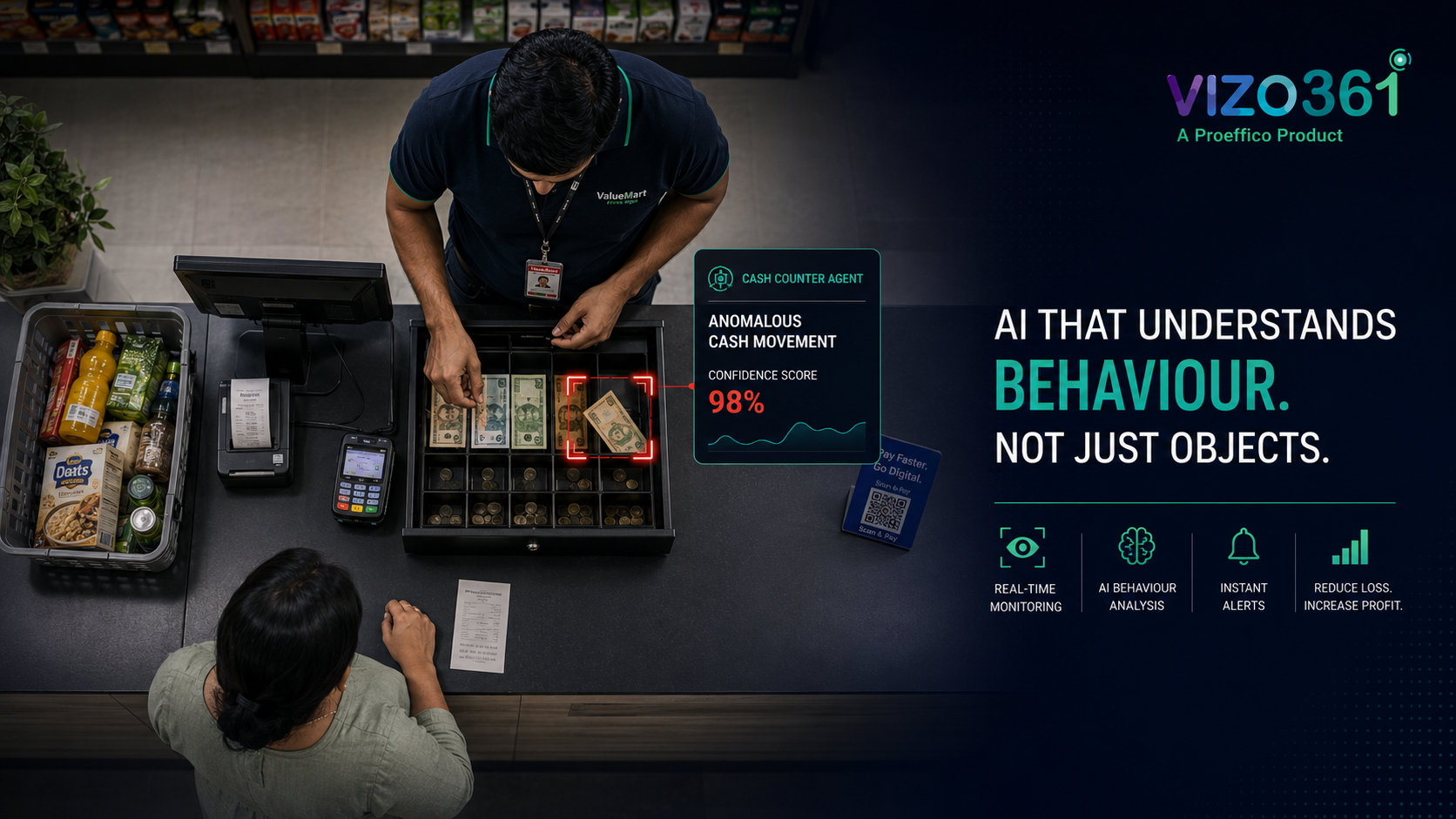
Suspicious hand movements near the cash drawer are flagged through gesture detection calibrated to the cash-handling environment. The system is not looking for generic motion — it is looking for movement patterns that are inconsistent with normal transaction flow: repeated contact with the drawer without a corresponding POS event, contact timing that does not align with a visible customer interaction.
Drawer events without a transaction are one of the clearest signals available. When a cash drawer opens and no transaction is registered in the POS in the same window, that is an event worth reviewing — every time. Manually cross-referencing drawer-open events from CCTV footage against POS logs is a full-time job. The cash-counter agent does it continuously.
Multiple voids in a session become meaningful when video context is added to POS data. A single void in isolation is common and legitimate. Three voids in forty minutes, flagged alongside phone-in-hand events at the same terminal, is a pattern the POS log alone would never surface.
Crowd density at checkout is a secondary but important signal. When queue congestion at a checkout is high, cashiers know they are less observed — not because there is no camera, but because supervisors are managing flow, not watching individual transactions. The agent monitors density at the checkout zone and flags periods where congestion is likely to reduce oversight, allowing supervisors to position appropriately.
How the alert reaches your store manager — not your security team
Detection is only useful if the alert reaches someone who can act on it before the shift ends. VIZO361's alert routing is configurable per event type. Cash-counter events — which are operationally sensitive and should not trigger a security response before a manager has verified the clip — route to the store manager or duty supervisor by default, not to a central security desk.
Each alert carries a timestamped video clip, the camera ID, and the event type. A store manager receiving a cash-counter alert does not need to review forty minutes of footage — they receive a clip of the flagged moment, the event classification, and a confidence score. The confidence threshold is adjustable during the tuning period so that high-certainty events are acted on immediately while borderline detections are queued for end-of-shift review.
Alerts can be delivered via SMS, an in-dashboard notification, or integrated into existing operations communication channels. The goal is that the right person sees the alert within the shift, not the next morning.
Works on the cameras you already have above your POS
The most common question from retail operations teams is whether existing cameras are good enough. In most cases, yes. VIZO361 connects over RTSP and ONVIF protocols and is compatible with 40+ camera brands, both IP and legacy analog. If your POS counter has a camera pointed at it today, that is the sensor for the cash-counter agent.
There is no new cabling, no hardware procurement, and no disruption to a live store during deployment. The AI is the upgrade, not the camera.
Processing happens at the edge — video is analysed in-store and alert clips are extracted there, rather than streaming raw footage to a cloud server. That design choice matters for the Indian retail context: most store-level broadband is not enterprise-grade, and keeping footage on-site addresses data-handling concerns that frequently block cloud surveillance adoption. VIZO361 is ISO 27001-certified, and that certification covers data handling, access controls, and storage — not just a badge on the product page.
The broader picture of how VIZO361 works across your existing CCTV infrastructure — from protocol support to edge architecture — is covered in detail in the AI CCTV for retail shrinkage in India post.
How to deploy: start with your highest-discrepancy store
The retailers who get the most value from cash-counter AI monitoring are not the ones who deploy chain-wide on day one. They are the ones who identify the single store with the largest unexplained cash variances — or the most recent POS anomalies — and prove the system there first.
A practical pilot runs for three to four weeks. During that period, the primary objective is not catching every event — it is calibrating the agent to your specific store environment. Lighting levels, counter layout, cashier positioning, and peak-traffic patterns all affect detection. Tuning the confidence threshold during this window reduces false positives before you expand to additional locations.
The metrics that determine whether to expand are straightforward: what percentage of alerts were actionable, how quickly did the manager receive and act on the alert, and did unexplained cash variances change during the pilot period compared with the prior four weeks.
Once one store proves its alert quality and manager response rate, rolling out to remaining stores in the chain is a software configuration exercise. No hardware project, no multi-store installation timeline.
Combining the cash-counter agent with footfall and queue density monitoring adds a second layer of context: peak-period congestion at checkout correlates with higher cash-handling risk, so the two agents together give supervisors both a transaction-level alert and a store-level density picture in the same dashboard.
The honest limitation: camera placement still matters
AI on existing CCTV works within the constraints of what those cameras actually see. A cash-counter agent cannot compensate for a camera pointed at the wrong angle, a lens covered in dust, or a counter layout where the drawer is outside the camera's field of view. The first step in any VIZO361 retail deployment is a camera audit — assessing what your existing infrastructure actually covers before deciding which agents to activate where.
That audit adds a week to the deployment timeline. It prevents a month of ambiguous results. Buyers evaluating any AI surveillance vendor should ask for this step explicitly, not just a demo on a controlled environment. A controlled demo will always look better than a live store. The question is how the system performs on your cameras, in your lighting, with your cashier workflow.
Where POS data makes the picture complete
Video evidence of a drawer event is a strong signal. A corresponding void or anomalous transaction in the POS log at the same timestamp is a case. The two together move loss prevention from suspicion to a documentable record that supports an HR or legal process.
For retail chains that want to close the loop between camera-side events and transaction-side data, MaximPro POS for retail chains — which pairs with VIZO361 for integrated shrinkage control — provides the transaction layer. A video alert at 14:47 and a void at the same terminal at 14:48 is not a coincidence. That correlation is what moves a suspicion from "something seems off" to a timestamped record of what happened.
Frequently Asked Questions
What is cashier fraud and how common is it in Indian retail?
Cashier fraud at the POS takes three main forms: skip-scanning (a high-value item passes the counter but a keypress voids or replaces it with a cheaper SKU), void abuse (cancelling a completed transaction for a known customer so the goods leave without revenue being recorded), and unauthorised drawer manipulation (opening the cash drawer between transactions or pulling change before a sale closes). With roughly 70% of Indian retail transactions still involving cash, the volume of cash-handling events per shift is higher here than in most comparable markets, and the opportunity for a pattern to go undetected is real.
What specific behaviours does VIZO361's cash-counter agent detect at the POS?
The agent monitors the area around the POS terminal for phone use at the till (one of the most reliable early indicators of intentional fraud), suspicious hand movements near the cash drawer, drawer openings without a corresponding transaction, and multiple void events in a session. Each alert is delivered as a timestamped video clip routed to the store manager or duty supervisor — not to a central security desk that reviews footage the following morning.
Does AI cash counter monitoring require replacing the cameras above my POS counters?
No. VIZO361 connects over RTSP and ONVIF protocols to existing IP and analog cameras. If you have a camera pointed at the cash counter today, that is the sensor. There is no new cabling, no hardware procurement, and no disruption to a live store during deployment.
How does AI at the POS differ from simply reviewing CCTV footage after a cash variance?
End-of-day CCTV review tells you a loss occurred and gives you footage to search — but you must already suspect a time window or a cashier. AI cash-counter monitoring generates a real-time alert at the moment a flagged behaviour occurs, with a timestamped clip of the specific event. The difference is between discovering a variance at month-end and receiving an alert at 2:47 pm on a Tuesday, during the shift in which it happened.
How do I know whether AI cash-counter monitoring will actually work in my store's conditions?
Camera placement, angle, lighting, and counter layout all affect detection quality. A camera pointed at the wrong angle or a counter where the cash drawer is outside the camera's field of view will produce poor results regardless of the AI. The right evaluation method is a pilot on your own cameras at your highest-discrepancy store — not a vendor demo in a controlled environment. A practical pilot runs three to four weeks, using the first two weeks for calibration and confidence-threshold tuning before assessing alert quality against your store records.
Bottom line
Cash counter theft detection at the POS level is not a complicated technology problem — it is a visibility problem. Retailers already have cameras above their tills. What most lack is the layer between "recording" and "acting," the difference between discovering a variance at month-end and receiving an alert during the shift in which it happened.
VIZO361's cash-counter agent adds that layer to the infrastructure you already own: phone-in-hand detection, drawer events without a transaction, suspicious gesture patterns — all routed to your store manager with a timestamped clip, not to a security inbox no one checks until morning.
The most effective way to evaluate it is on your own camera feed, on your highest-discrepancy store. See how VIZO361 for retail chains is configured and book a demo on your actual POS cameras. For a broader view of how Proeffico approaches retail AI — from video analytics to POS to operational intelligence — visit Proeffico's retail AI solutions.