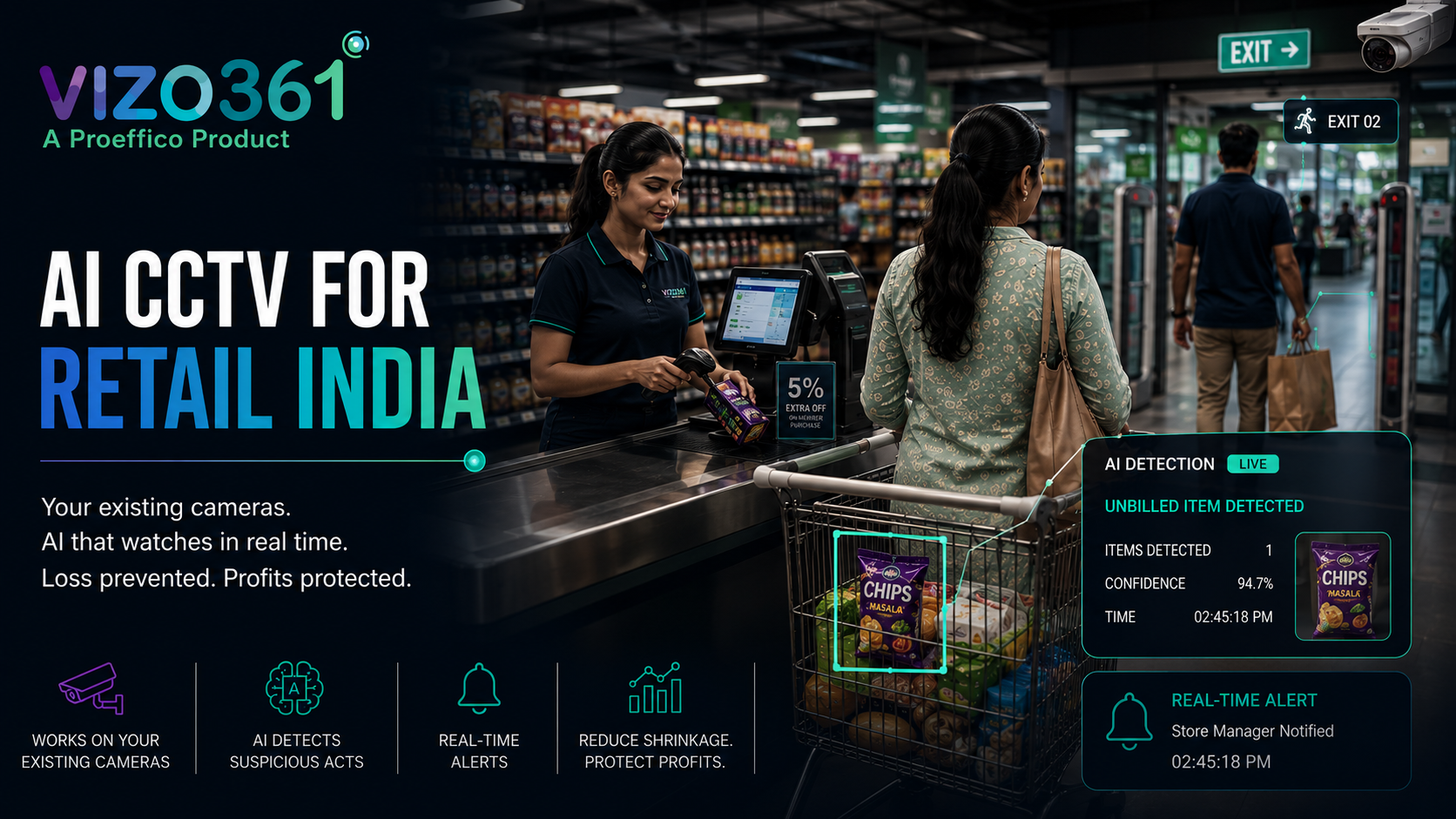
Indian retailers already own the cameras. The footage is recording. And shrinkage is still climbing — discovered at month-end stock count, long after the loss walked out the door. The problem was never the hardware. It was that no one was watching in real time. AI CCTV for retail in India changes that equation without touching a single cable.
This piece covers the specific loss vectors Indian retailers face, the agents that address each one, how the technology works on cameras you already own, and how to build a business case that doesn't require a capital expenditure approval.
Where retail shrinkage comes from — and where your current CCTV fails
Shrinkage in Indian retail falls into three buckets, and most store-level CCTV addresses none of them well in real time.
External theft at shelves and exits is the visible category — the one most loss-prevention conversations start with. But unmonitored exits during peak congestion and blind spots near gondola ends are harder to watch than most retailers acknowledge.
Cashier-side fraud is the underreported one. Skip-scanning (an item passes the scanner but a keypress voids the transaction), and unauthorized discounts all look like legitimate transactions in a POS log. Research consistently puts internal fraud — employees, not external shoplifters — at roughly 30–40% of total retail shrinkage. The number is probably higher in India because cashier-side fraud is buried in POS noise.
Dock and backroom pilferage are the least-watched category. Deliveries are received, counted by one person, and logged. Discrepancies surface days later. Unscheduled vehicle arrivals at a loading dock rarely trigger any alert at all.
The fundamental failure of traditional CCTV in all three scenarios is the same: a guard cannot watch 40 feeds simultaneously, and review-after-the-fact means you are gathering evidence, not preventing loss. The stock-count model of shrinkage discovery is a month's worth of loss accepted as the cost of operations. It doesn't have to be.
What AI actually detects on a retail camera feed
VIZO361 approaches retail surveillance through focused agents — each one built around a specific risk, not a generic "AI detects theft" promise. That specificity is what makes it deployable and measurable.
The cash-counter monitoring agent is the highest-value starting point for most retailers. It watches the three square feet around the POS terminal and flags: phone use at the counter, unusual hand movements near the cash drawer, and drawer openings without a corresponding transaction event. Phone-in-hand detection (PIH) at the till is not just a distraction issue — it is one of the most reliable early signals of intentional fraud, because phone activity at a cash counter during a transaction is almost never innocent. You can read more about how VIZO361's cash-counter monitoring agent works and what it flags.
The footfall analytics and queue detection agent does more than count customers. It correlates customer density in a zone with inventory movement, so anomalies — a spike in footfall near a high-value display with no corresponding sale — surface as an alert, not as a spreadsheet discrepancy three weeks later. Queue depth and dwell time also inform staffing decisions, which is a secondary benefit that loss-prevention managers rarely expect. Explore footfall analytics and queue detection in detail.
The ANPR-sentinel agent (Automatic Number Plate Recognition) solves the loading-dock problem. Every vehicle arrival and departure is logged automatically. Unscheduled entries generate an alert. If a vehicle that should have left was still on site during a stock discrepancy window, you have a timestamp. That's a searchable record, not a recollection.
Phone-in-hand detection in cash-handling zones goes beyond just the POS terminal. In stockrooms, in counting rooms, in any area where staff handle cash or high-value inventory, a phone in use is a variable to control. The agent flags the event; the response is yours to define.
Crowd density monitoring addresses the specific risk of unmonitored exits during peak congestion. When footfall near an exit exceeds a threshold, the alert lets staff reposition — before the queue becomes a cover for an exit event, not after.
Works on the cameras you already own — no rip-and-replace
The conversation about AI video analytics in Indian retail often stalls at hardware. It shouldn't.
VIZO361 connects over RTSP and ONVIF protocols to 40+ camera brands — both IP and legacy analog infrastructure. If your cameras are recording today, they can run VIZO361 analytics tomorrow. There is no cabling project, no capital expenditure approval for new hardware, and no "rip-and-replace" disruption to a live store.
Processing happens at the edge, which means footage does not need to travel to a cloud server to be analyzed. That matters for two reasons in the Indian context: bandwidth in most store locations is not enterprise-grade, and keeping footage on-site addresses the data-privacy concerns that prevent many retailers from committing to cloud surveillance.
For a deeper look at how the underlying technology works, how video analytics surveillance works in practice covers the full architecture without jargon.
How to build the business case — start with one site, one problem
The retailers who get the most out of AI surveillance are not the ones who deploy everywhere at once. They are the ones who identify the single highest-loss location and the suspected primary leak — POS fraud versus external shelf theft versus dock discrepancy — and prove the system on that problem first.
A practical pilot looks like this: two or three agents deployed on a handful of cameras at one site for three to four weeks. The metrics that matter are not "how many alerts did it generate" but "what percentage of alerts were actionable" and "how quickly did a manager receive and respond." A system that fires 40 false alerts a day will be muted by week two. A system with a low false-alert rate in a live retail environment — not a demo environment — will be trusted and expanded.
Once one site proves its catch rate and response time, rolling out agent-by-agent across the chain is a software configuration exercise, not a hardware project.
For retailers already managing multi-outlet operations, the shrinkage problem does not live in isolation from POS data. Anomalies in video are most useful when they can be cross-referenced with transaction data — which is where MaximPro POS for retail chains creates a coherent picture across both systems. A video alert at a POS terminal and an anomalous transaction in the same two-minute window is evidence; either one alone is a hypothesis.
Three questions every retail buyer should ask any vendor
- Does it run on my existing cameras without new hardware? If the answer involves a minimum camera spec list or a hardware upgrade, add that cost to the real price of the system before comparing.
- What is the false-alert rate in a working retail environment — not a demo? Demo environments are controlled. A live store has variable lighting, staff movement, and seasonal peak traffic. Ask for a reference site you can call, not a case study PDF.
- How does the alert reach my store manager, and in how many seconds? Detection without a fast, reliable notification chain is not loss prevention. It is delayed evidence.
The honest limitation
Camera placement, angle, and lighting still govern accuracy. An AI agent cannot compensate for a camera pointed at a wall, a lens that hasn't been cleaned since installation, or a blind spot that was acceptable for passive recording but defeats active monitoring. The first step in any VIZO361 retail deployment is a camera audit — understanding what your existing infrastructure actually sees before deciding which agents to run where. That audit adds a week to the timeline, but it prevents a month of disappointing results.
AI on existing CCTV is not a guarantee against shrinkage. It is the fastest path from "we think we have a problem" to "we know exactly where and when it is happening" — and that visibility is what makes targeted intervention possible.
Frequently Asked Questions
Does AI CCTV for retail work on my existing cameras, or do I need new hardware?
VIZO361 connects over RTSP and ONVIF protocols and is compatible with 40+ camera brands — both IP and legacy analog. If your cameras are recording today, they can run AI analytics without new cabling or hardware procurement. The AI is the upgrade, not the camera.
What is the difference between AI retail surveillance and ordinary CCTV recording?
Traditional CCTV records footage for review after a loss has occurred. AI video analytics monitors feeds in real time and generates an alert at the moment a suspicious event happens — a phone in hand at the POS, a drawer opening without a transaction, or an unscheduled vehicle at the loading dock. The difference is between discovering shrinkage at month-end stock count and receiving an alert during the shift it happens.
What types of cashier fraud can AI actually detect at the POS counter?
VIZO361's cash-counter agent monitors for phone use at the till, suspicious hand movements near the cash drawer, drawer openings without a corresponding transaction, and multiple void events in a session. These are the specific behaviors associated with skip-scanning, void abuse, and cash-handling manipulation — the three most common forms of internal retail fraud in India.
How does shrinkage from internal theft compare to external shoplifting in Indian retail?
Research consistently puts internal fraud — employees rather than external shoplifters — at roughly 30–40% of total retail shrinkage. In Indian retail, where cashier-side fraud can appear as a legitimate voided transaction in a POS log, the figure is likely underreported. AI monitoring at the cash counter addresses internal loss vectors that passive CCTV cannot catch.
How long does a VIZO361 retail pilot take before it produces usable results?
A practical pilot deploys two or three agents on a handful of cameras at one site for three to four weeks. The first two weeks are used for calibration — tuning confidence thresholds to your store's specific lighting, traffic, and cashier workflow. Actionable alert data typically emerges in weeks three and four.
Final Thought
Retail shrinkage in India is not a new problem, and most retailers already have the cameras to address it. What they lack is the layer between recording and acting. VIZO361's retail agents — cash-counter monitoring, footfall analytics, ANPR at the dock, phone-in-hand detection — add that layer to the infrastructure you already own, without a capital project and without disrupting a live store.
The fastest way to evaluate it is on your own camera feeds, on your highest-loss site. Everything else is a vendor's claim. See how VIZO361 for retail chains is configured and book a demo on your own cameras. Proeffico's broader retail AI work — spanning video analytics, POS integration, and operational intelligence — is available at Proeffico's retail AI work.