AI Perimeter Security Systems: Detect Intrusions Before They Escalate (2026)
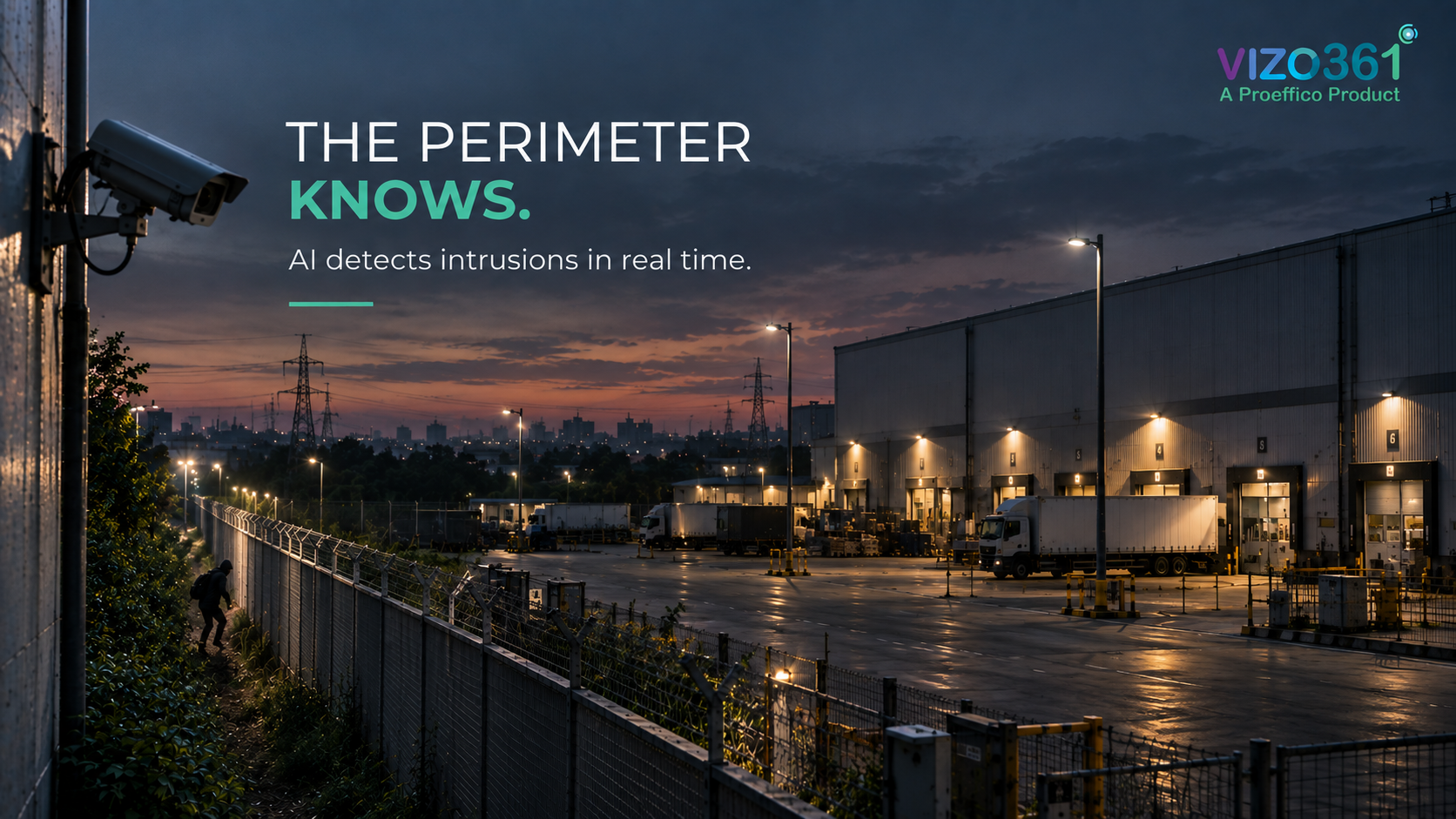
A boundary wall, a night guard, and a bank of CCTV monitors nobody is watching after 11 pm — that's still how most Indian factories, warehouses, and campuses secure their perimeter. It works, mostly, until the one night it doesn't: a cut fence panel, a gate left ajar during a shift change, someone walking the boundary looking for the weak spot. By the time anyone notices, the intrusion is already over and the response is a police report and a review of last night's footage.
An AI perimeter security system flips that order. Instead of relying on a person to catch movement on a wall of screens, software watches every camera feed continuously and raises an alert the moment someone or something crosses a line it shouldn't. The goal isn't to replace guards or fencing — it's to make sure that when a breach happens, someone actually finds out about it while there's still time to act.
Why Fences and Guards Miss Intrusions
Physical perimeter security has three structural weak points, and they show up in almost every incident review.
First, guards can't watch everywhere at once. A single security post covering a 2-acre plant or a warehouse cluster with multiple gates is watching one direction while the breach happens in another. Fatigue on long night shifts makes this worse — attention naturally drops in the small hours, which is exactly when most perimeter breaches occur.
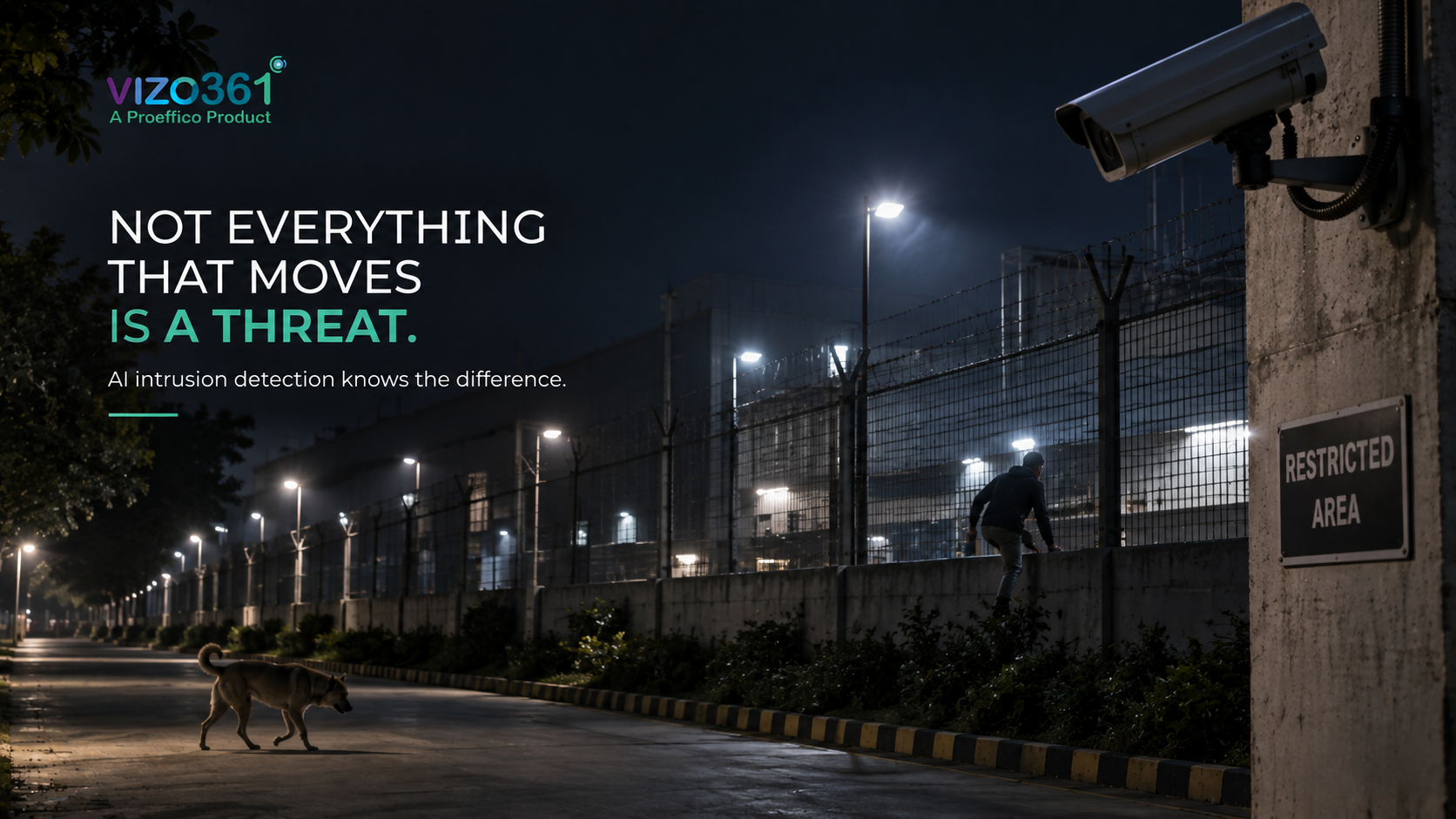
Second, traditional motion-based alarms and trip wires generate so many false triggers — a stray dog, wind-blown debris, a passing vehicle's headlights sweeping the fence line — that teams learn to tune them out or disable them entirely. A system that cries wolf every night gets ignored on the one night it's right.
Third, most CCTV footage today is used forensically, not operationally. Cameras record continuously, but nobody is reviewing all of it live, so the recording becomes evidence for an FIR after the fact rather than a tool that stops the incident from happening. For a manufacturing site or logistics hub, that gap between "we have the footage" and "we found out in time" is where the real cost sits — in stolen raw material, damaged fencing, or a security lapse that shows up in an insurance claim.
How AI Perimeter Detection Works
An AI perimeter security system runs computer vision models on your existing camera feeds and applies rules specific to what "normal" looks like at your boundary. You define virtual lines and zones on the camera view — the fence line, the gate approach, a restricted yard — and the system watches for objects crossing them.
The important difference from a basic motion sensor is that the software classifies what it sees before it decides to alert. It distinguishes a person or vehicle from a leaf, a bird, or a shadow, and it can apply time-based rules — for example, treating movement near the loading gate as normal during working hours but flagging the same movement at 2 am. Detection logic typically covers line-crossing (someone stepping over a defined boundary), loitering (a person lingering near a gate or fence for longer than a set threshold), and zone intrusion (entry into an area that should be empty, like a fuel yard or a raw-material store after hours).
Because this runs on the video feed itself, it works with cameras you already have installed — VIZO361's platform is built specifically to layer this kind of analytics onto existing CCTV rather than requiring specialised sensor hardware or a rip-and-replace of your camera estate.
Real-Time Alerts vs After-the-Fact Review
This is the part that actually changes the outcome. A system that only helps you review footage after an incident is a documentation tool. A system that pushes a real-time alert — to a guard's phone, a control room screen, or a WhatsApp group — the moment a breach happens is a prevention tool.
The practical difference is measured in minutes. A guard reviewing 40 camera feeds might catch a breach a few minutes late, or not until the morning shift change. An automated alert with a snapshot and camera location reaches the response team within seconds of the event, while the intruder is likely still on the property. That window is what determines whether a security team can actually intervene — dispatch a patrol, lock down a gate, call the police — versus simply having a clean record of what was stolen or damaged.
For manufacturing plants and warehouses, this real-time layer also reduces the load on the security team itself. Instead of staring at monitors for eight hours hoping to catch something, guards respond to specific, verified alerts — which is a very different (and more sustainable) job than continuous visual monitoring.
Best-Fit Sites
Perimeter AI earns its keep fastest at sites with a defined boundary, meaningful assets inside it, and limited overnight staffing. That covers a wide range of the sites VIZO361 works with:
- Manufacturing plants and factories — large open boundaries, raw material and finished-goods yards, and shift patterns that leave the site thin on people overnight.
- Warehouses and logistics parks — high-value inventory, multiple gates and loading bays, and third-party transport movement that makes "who's supposed to be here" harder to judge by eye.
- Corporate and industrial campuses — multi-building sites where a single guard post can't realistically cover every fence line and access point.
- Utility and infrastructure sites — substations, water treatment facilities, telecom towers — remote, unmanned or lightly manned, and attractive targets for cable and equipment theft.
Sites that are compact, already well-lit, and staffed with a guard actually watching the boundary continuously get a smaller lift from adding AI detection — though even there, it typically pays for itself in reduced false-alarm fatigue and better shift accountability. If your site's biggest security cost has been reactive — replacing stolen material, patching cut fencing, insurance claims after the fact — that's the clearest sign perimeter AI is worth evaluating.
Running It on Existing Cameras
The most common objection to "AI security" is the assumption it means a new hardware project — thermal cameras, radar, buried sensors, months of installation. That's not how this has to work. VIZO361 runs its perimeter and intrusion detection analytics as a software layer on top of the CCTV infrastructure a site already has, provided the cameras have reasonable night coverage of the boundary (IR or low-light cameras help significantly for after-dark detection).
Deployment typically means connecting existing camera feeds to the platform, marking the virtual boundary lines and restricted zones on each relevant camera, setting alert rules and recipients, and testing detection accuracy across a few nights before going fully live. There's no need to dig trenches for buried cable or mount new sensor arrays along the fence line — which keeps both the cost and the installation timeline well below what a dedicated perimeter-sensor project would require. Sites with camera blind spots — dark corners, missing coverage at a specific gate — still need those gaps addressed, since AI analytics can only act on what a camera can actually see.
If you're evaluating a system like this, it's worth reading how the same underlying video analytics platform applies inside a plant boundary, in our guide to AI CCTV for manufacturing plants, and how it extends to loading bays and stock areas in warehouse video analytics. For a closer look at how the detection engine itself cuts down false alarms, see AI intrusion detection on CCTV.
Frequently Asked Questions
What is an AI perimeter security system?
It's software that applies computer vision to CCTV camera feeds along a site's boundary to automatically detect intrusions — people or vehicles crossing a defined line, entering a restricted zone, or loitering near a gate — and send a real-time alert instead of relying on a guard to spot it manually.
Do we need new cameras or sensors to add AI perimeter detection?
Not necessarily. VIZO361's platform is designed to run on existing CCTV, provided the cameras have adequate coverage and reasonable night visibility along the boundary. Sites with significant blind spots or very poor low-light footage may need camera upgrades in specific areas, but a full sensor or hardware replacement usually isn't required.
How is this different from a regular motion-sensor alarm?
Motion sensors trigger on any movement — an animal, blowing debris, weather — which leads to frequent false alarms that teams eventually start ignoring. AI perimeter detection classifies what it sees (person, vehicle, animal) and applies context like time of day and zone rules before alerting, which meaningfully cuts down on false positives.
How fast are alerts, and who receives them?
Alerts are generated in real time as the event is detected on camera and can be routed to a guard's phone, a control room dashboard, or a group like WhatsApp, typically including a snapshot and the camera or zone location.
Which sites benefit most from perimeter AI?
Sites with a defined boundary, valuable assets inside it, multiple access points, and limited overnight staffing see the fastest payback — manufacturing plants, warehouses and logistics parks, industrial and corporate campuses, and utility or infrastructure sites are the most common fits.
An AI perimeter security system doesn't replace your fence or your guards — it makes sure that when someone tests either one, your team finds out while it still matters. If your site's cameras are already up but nobody's watching them around the clock, that's the gap worth closing first.