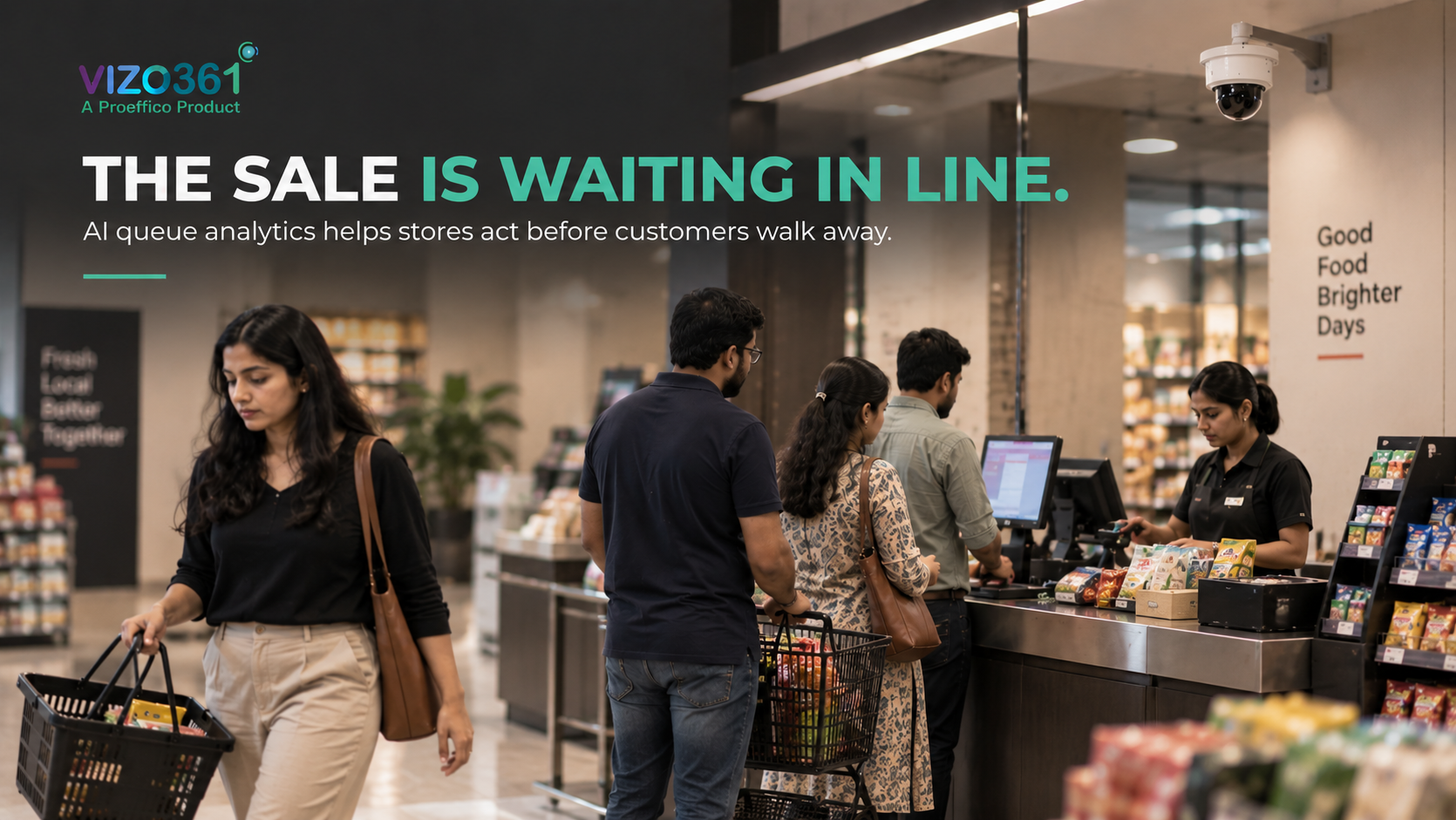
A shopper picks up everything on their list, walks toward the checkout, sees four people ahead of them at the only open till, and puts the basket down. No complaint, no scene — just a lost sale and a customer who quietly decides to try the next store. This is the everyday, invisible cost that a retail queue management system is built to solve: not fraud, not theft, just friction at the one moment where the sale actually closes. Most retail chains already have the hardware to fix this. The cameras above the checkout counters have been recording queues for years — the problem is nobody was watching them in real time or turning that footage into a number a store manager could act on. That's the gap AI queue analytics closes, and it's why "retail queue management" has become one of the more practical, ROI-visible applications of computer vision in Indian and GCC retail. ## Why Long Queues Cost You Sales Queues don't just annoy customers — they change buying behaviour in ways that are easy to miss on a P&L until you start measuring them. A shopper standing in a long line will often abandon secondary items in the basket, skip the impulse-buy aisle near billing, or leave altogether if the wait crosses their personal patience threshold. In quick-service restaurants and fuel-station convenience stores, where the whole value proposition is speed, a visibly long queue can turn away walk-in footfall before anyone even joins the line. The tricky part is that store managers rarely see this loss directly. They see footfall counts and daily sales, but not the shopper who turned around at the door, or the till that stayed short-staffed through the 6-9 PM rush because nobody flagged it in time. What retailers consistently report anecdotally — and what queue analytics makes visible — is that the wait is longest exactly when footfall (and revenue opportunity) is highest: weekend evenings, festive season, and lunch-hour rushes. ## How Queue Analytics Works A retail queue management system doesn't require new cameras or a fresh round of capex. VIZO361 runs as an AI layer on top of the CCTV (closed-circuit television) you already have installed at checkout counters, entrances, and billing zones. The video feed goes through the same VMS (video management system) infrastructure your store already uses for security — the analytics engine simply reads the video stream and does the counting and measuring a human never could, continuously and without breaks. In practice, this means the system draws virtual zones and lines over the checkout area in software — no tape on the floor, no sensors under tiles. It then tracks how many people are standing in each queue zone, how long each person dwells in that zone before reaching the counter, and how that number moves through the day. Because it's built on the same computer-vision engine VIZO361 uses for footfall counting elsewhere in the store, a retailer already running footfall analytics can usually switch on queue monitoring at checkout with the same camera infrastructure, rather than treating it as a separate project. ## Real-Time Staffing Alerts Counting queue length after the fact, in a weekly report, doesn't help the customer standing there right now. The part that actually changes outcomes is the real-time alert: when the queue at a counter crosses a length or wait-time threshold you've set — say, five or more people waiting, or an average wait past a set number of minutes — the system pushes a notification to the store manager's device or a floor display, prompting them to open another till or call in a floater from the sales floor. This is a deliberately simple intervention, and that's the point. Store managers on a busy floor are juggling stock, staff, and customer queries; they can't watch every checkout counter at once, especially across multiple lanes or, for chains, across multiple stores from a regional office. An automated alert does the watching so the manager only has to act when it matters — which is a very different workload than staring at a bank of CCTV monitors hoping to catch a queue building. ## Metrics That Matter Not every number a camera can produce is worth a manager's attention. The ones that consistently matter for a retail queue management system are:
- Average wait time per checkout counter, tracked by hour, so you can see exactly when service breaks down.
- Queue length over time, to catch counters that consistently run over threshold versus one-off spikes.
- Peak-hour and peak-day patterns, which usually differ by store location and matter directly for staff rostering.
- Counter-to-counter comparison, useful for chains to spot which stores or which specific tills are chronically understaffed.What retailers should resist is treating every metric equally. A single long queue during a flash promotion is expected and not worth an operational fix; a queue that's consistently long every Friday evening at the same counter is a rostering problem, and that's the pattern queue analytics is meant to surface over weeks, not a single shift. ## Getting Started With a Retail Queue Management System The practical path for most Indian and GCC retail chains is to pilot on the highest-footfall stores first — the ones where staffing decisions already have the biggest revenue impact — rather than a chain-wide rollout on day one. Because VIZO361 works on existing CCTV, there's no new hardware to procure or install; the analytics layer connects to the camera feeds you already have, and dashboards can be reviewed at store level or rolled up for a regional or head-office view. For chains that also run distribution centres or back-of-store stockrooms, the same video-analytics approach extends naturally into warehouse video analytics for loading-bay and stock-movement visibility — useful context if queue delays are traced back to a billing counter waiting on a manual price check because stock data wasn't synced. Retailers concerned about after-hours store security or back-entrance access can pair queue monitoring with AI perimeter security and AI intrusion detection running on the same camera network, since it's the same underlying platform doing the work across use cases. It's worth confirming module and pricing details directly at vizo361.ai since specific modules available may vary by deployment. Data handling is a fair question to ask any vendor before rollout — VIZO361 is built to ISO 27001 standards for information security, and it's reasonable to ask any retail queue management system provider for their compliance documentation before connecting it to live store cameras. ## Frequently Asked Questions
Does a retail queue management system need new cameras?
No, not with VIZO361. The analytics engine runs on the CCTV already installed at checkout counters and entrances — there's no rip-and-replace of existing camera infrastructure required.
How is queue length measured without sensors on the floor?
The system uses computer vision to draw virtual zones and lines over the video feed in software, then counts and tracks people within those zones — no physical sensors, floor mats, or beacons needed.
Can it alert staff in real time when a queue gets too long?
Yes. Once a queue crosses a length or wait-time threshold you configure, the system can push a real-time alert to a manager's device so an extra till can be opened before customers start walking away.
Is queue analytics useful for chains with multiple stores?
It's particularly useful there — a regional or head-office view can compare wait times and queue patterns across stores and counters, which is difficult to do manually when managers only see their own floor.
Does queue monitoring raise privacy concerns for customers?
The analytics is built around counting and measuring people in zones (queue length, dwell time), not identifying individual shoppers, which is a meaningfully different data footprint than facial-recognition use cases. Retailers should still review their own data-handling policy and disclosure signage with their compliance team before deployment.