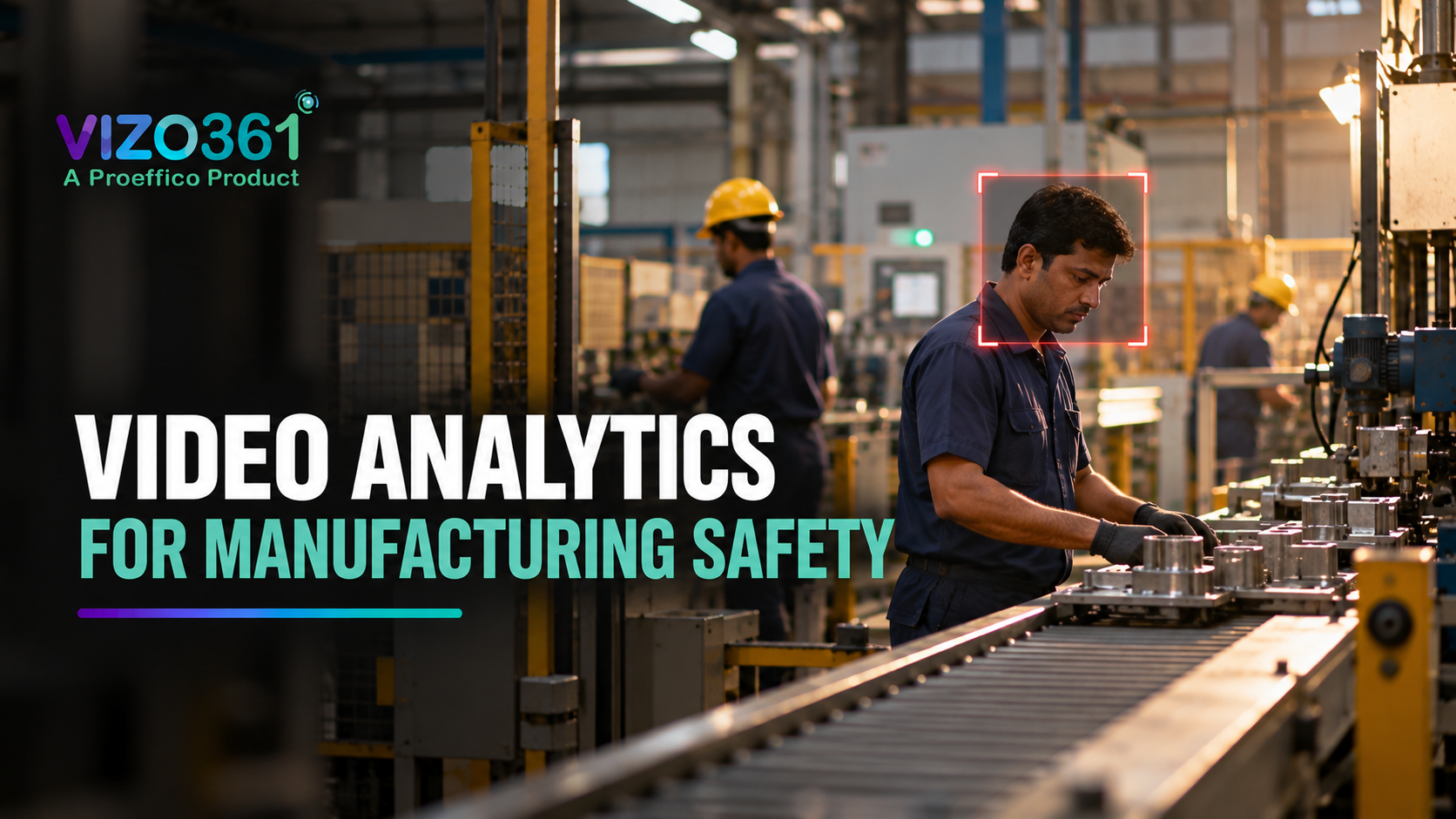
Most factory safety incidents don't happen because nobody was watching — they happen because nobody was watching *that* corner, at *that* moment, when a worker walked past a moving conveyor without a helmet. Video analytics for manufacturing safety closes that gap by turning the CCTV a plant already has into a system that watches every zone, every shift, without needing a human glued to a monitor bank. This is where VIZO361's approach differs from a standard NVR setup: the cameras don't just record what happened — they flag what's happening, while it's still preventable. ## Why safety incidents go unseen Walk into most Indian manufacturing plants and you'll find CCTV covering the shop floor, the loading docks, the material handling zones — and a security room where one or two people are supposed to watch dozens of feeds at once. That model breaks down for a simple reason: human attention doesn't scale with camera count. A few patterns show up again and again in plants that later review an incident: - The camera *had* the footage, but no one was looking at that feed when it mattered. - PPE non-compliance (no helmet, no gloves, no safety harness) is a slow habit that builds up over weeks before it causes an injury — and it's invisible to spot-checks. - Near-miss events near forklifts, cranes, or high-voltage areas rarely get logged at all, because there's no injury to trigger a report. - By the time HR or the safety officer reviews footage after an incident, it's for the post-mortem — not for prevention. Video analytics doesn't replace supervisors or safety officers. It gives them a system that's actually watching all the time, and that only interrupts them when something needs a human decision — a worker in a restricted zone, a missing hard hat near an overhead crane, smoke where there shouldn't be any. ## PPE and compliance detection The most common ask VIZO361 gets from plant safety teams is straightforward: can the cameras tell us who isn't wearing what they're supposed to be wearing, before it becomes a compliance audit finding or, worse, an injury report? On existing CCTV, video analytics can be configured to detect specific PPE categories per zone — because a welding bay and a warehouse aisle don't need the same gear: - Helmets/hard hats in overhead-hazard zones - High-visibility vests in vehicle movement areas - Gloves and eye protection at specific workstations - Safety harnesses at height (mezzanine, scaffolding, elevated platforms) When the system detects a gap — a worker without a helmet crossing into a marked zone — it can raise a real-time alert to the shift supervisor rather than waiting for a manual walk-through. That shifts PPE enforcement from a periodic spot-check (which workers learn to anticipate) to a continuous, zone-specific check that doesn't depend on someone remembering to look. It's worth being direct about the limits here: PPE detection accuracy depends heavily on camera placement, lighting, and how cluttered the frame is — a poorly angled camera above a busy assembly line will miss more than a well-positioned one at a doorway or chokepoint. Any vendor promising perfect detection in every condition isn't being straight with you. The honest goal is a meaningful reduction in blind spots, not a zero-miss guarantee. ## Restricted-zone and proximity alerts Beyond PPE, a lot of manufacturing risk is about *where* people are relative to machinery, vehicles, and hazard zones — and that's a problem video analytics is well suited for. Common configurations plants run: - **Restricted-zone intrusion** — an alert the moment someone enters a marked no-go area: energized electrical panels, hot zones near furnaces, or areas cordoned off during maintenance. - **Proximity alerts near moving equipment** — flagging when a person gets too close to an operating forklift, AGV, or conveyor line, especially in blind-spot corners where the machine operator can't see them. - **Loading-bay and dock safety** — tracking vehicle and pedestrian movement together, which matters most during shift-change congestion when a plant sees the highest volume of near-misses. - **After-hours presence** — flagging any movement in production areas outside scheduled shifts, which doubles as both a safety and a security signal. These alerts route to the person who can actually act — a floor supervisor, a security desk, a safety officer's phone — rather than sitting in a log that gets reviewed once a week. For plants running multiple shifts with a lean safety team, that real-time routing is often the actual value: it's not that the camera "sees" something new, it's that the *right person finds out fast enough to do something about it*. This is the same underlying platform Proeffico's video-analytics customers use for loading-bay and dock monitoring in warehouses — the zone logic and alerting is largely the same problem, just applied to a manufacturing floor instead of a distribution center. If your site handles both warehousing and production, it's worth reading how the same approach plays out on the logistics side in our piece on [AI CCTV analytics for warehouses](https://vizo361.ai/blogs/ai-cctv-analytics-for-warehouses). ## Responsible, privacy-aware use Safety monitoring on the shop floor sits close to worker surveillance concerns, and plants that skip this conversation tend to run into resistance from the workforce — or from unions — later. A few principles worth building in from the start: - **Scope the analytics to safety and compliance, not general behavior monitoring.** PPE and zone alerts are defensible to a workforce; tracking individual productivity through the same cameras is a different conversation and should be handled separately, with its own consent and disclosure process. - **Be transparent that cameras are analytics-enabled.** Signage and communication to the workforce about what's being monitored (PPE, zone entry) and what isn't (facial identity logs for general tracking) reduces friction significantly. - **Control access to footage and alerts.** Not everyone who can view a live feed should be able to export or search historical footage — role-based access matters as much as the detection itself. - **Align with local labor and data-privacy norms.** Requirements vary by state and by whether the plant has union representation; safety teams should loop in HR and legal before rollout, not after. VIZO361 runs on ISO 27001-aligned infrastructure, which matters here specifically because safety footage and alert logs are sensitive data — they should be handled with the same rigor as any other operational record, not treated as an afterthought bolted onto a security camera feed. ## Getting started A plant doesn't need to instrument the entire facility on day one. The practical path most sites follow: 1. **Start with the highest-risk zones** — areas with a history of near-misses or incidents, or wherever the safety officer already knows compliance is inconsistent (loading bays, height work, machine floors). 2. **Confirm it works on existing cameras first.** VIZO361's whole premise is that the CCTV already installed doesn't need to be ripped out — the analytics layer runs on top of it, so the first step is usually a site walk to check camera angles, resolution, and lighting against the zones you want covered. 3. **Set alert routing before go-live**, not after. Decide who receives a PPE or zone-breach alert and what they're expected to do with it — an alert nobody acts on just becomes noise. 4. **Review a pilot period's data with the safety team** before expanding — what got flagged, what was a false positive, and where camera repositioning would help — then scale zone by zone. For plants that also run vehicle gates or logistics yards alongside production, pairing zone/PPE monitoring with [ANPR-based vehicle access control](https://vizo361.ai/blogs/anpr-number-plate-recognition-in-india) gives a fuller picture of who and what is moving through the site, not just what's happening inside the shed. ## Frequently Asked Questions ### Does video analytics for manufacturing safety require new cameras? No — VIZO361's video analytics is designed to run on the CCTV a plant already has, provided camera placement, resolution, and lighting are adequate for the zones being monitored. A site assessment during onboarding confirms which existing cameras are usable as-is and where placement adjustments would improve accuracy. ### How accurate is PPE detection in a real factory environment? Accuracy depends on camera angle, lighting, and how crowded the frame is — a camera positioned at a chokepoint or doorway will generally perform better than one covering a wide, cluttered assembly area from a distance. No vendor should promise zero missed detections; the realistic goal is a meaningful, measurable reduction in unmonitored blind spots. ### Can this system identify individual workers, or just detect PPE and zones? That depends on how it's configured. VIZO361 supports both zone/PPE-only monitoring (no individual identification) and identity-linked modules like facial recognition, which is a separate capability with its own consent and access-control requirements. Plants should decide the scope deliberately, with HR and legal involved, rather than defaulting to the most invasive configuration. ### Will alerts overwhelm the safety team with false positives? Poorly tuned zones and camera angles will generate noise, which is why a pilot period matters — reviewing early alerts with the safety team lets you narrow zone boundaries, adjust sensitivity, and reposition cameras before rolling out plant-wide. The goal is alerts the team can act on, not a stream nobody has time to review. ### How does this fit alongside existing safety audits and manual walk-throughs? Video analytics doesn't replace manual safety walk-throughs or statutory audits — it fills the gap between them. Instead of relying on periodic spot-checks that workers can anticipate, it gives the safety team continuous visibility into PPE compliance and restricted-zone entry, with audits and walk-throughs still handling what cameras can't: equipment condition, documentation, and procedural compliance. Manufacturing safety teams don't need another dashboard nobody checks — they need alerts that reach the right person before a near-miss becomes an incident report. [Book a demo - see it on your cameras](https://vizo361.ai/contact) and VIZO361 will show you what its video analytics platform picks up on your own plant's existing feed.
General 2026-10-24 8 min read VIZO361° Team
Video Analytics for Manufacturing Safety: PPE, Zones and Incident Alerts (2026)