Indian factories have cameras. Most of them are recording everything and actioning nothing. The violation that triggered last quarter's audit finding was on tape — reviewed the next morning, after the inspector had already walked off the floor. AI video analytics for manufacturing changes that equation: the same CCTV infrastructure, running agents that catch the violation the moment it happens, not the morning after.
This piece covers what that looks like in practice — which hazards it addresses, how deployment actually works in an Indian plant environment, and how to build the business case for management. Written from the ground up for EHS managers, plant safety officers, and operations heads evaluating a real deployment, not a pilot that never scales.
Why manual PPE audits are not working in Indian factories
A clipboard-based PPE check happens once per shift — maybe twice if the EHS manager is conscientious. Violations happen continuously: a worker removes their helmet in a heat zone, a contractor enters a chemical bay without a high-vis vest, a shift changeover leaves a gap in coverage for twenty minutes. None of that lands on the clipboard.
End-of-day CCTV review finds those violations hours after they occurred — and hours after a potential injury. That is not a safety record; it is a liability record.
The compliance pressure is intensifying. Tier-1 OEM customers in auto and pharma supply chains are now asking for PPE compliance logs by zone and by shift as part of supplier qualification audits. A clipboard cannot produce a per-zone, per-shift log with timestamps. The Factory Act, 1948 mandates PPE use in specified hazardous zones, and non-compliance carries personal liability for the safety officer. ISO 45001 certification requires evidence of ongoing monitoring — not quarterly audit reports.
The numbers behind safety incidents in India's manufacturing sector are publicly available and stark: ESIC data consistently shows that manufacturing accounts for a significant share of occupational injury claims, and industry estimates put the direct and indirect cost of a single lost-time injury — medical, productivity, and regulatory — in the range of several lakh rupees.
Manual monitoring is not a gap in the system. At Indian production volumes and shift densities, it is the system's limit.
What AI video analytics actually monitors on a factory floor
VIZO361 deploys as a set of focused agents — each one answers a specific hazard question rather than promising vague "AI surveillance." Here is what that looks like in a manufacturing context:
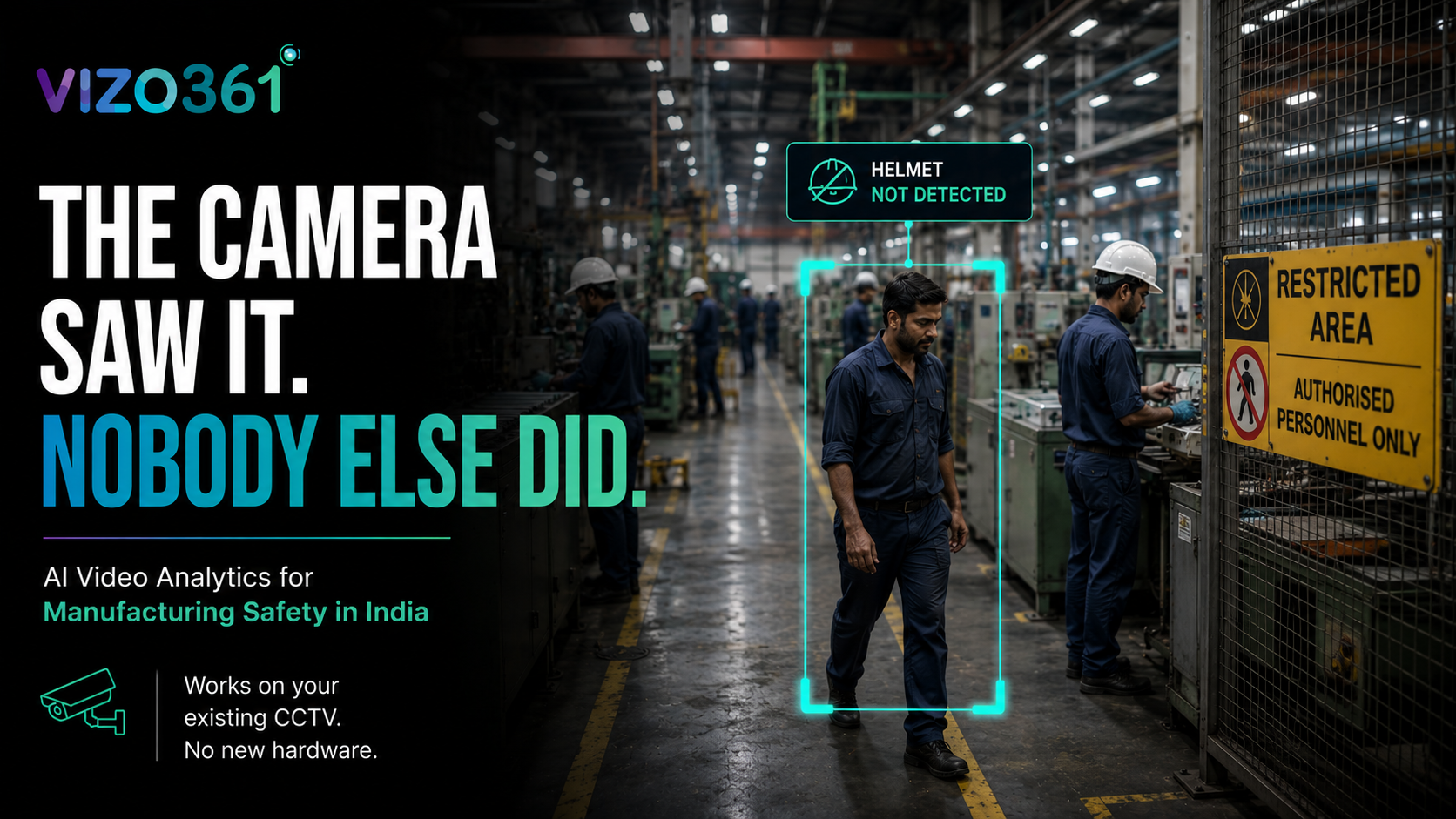
VIZO361's PPE-compliance agent monitors for helmets, high-visibility vests, and safety footwear at gate entry, zone entry points, and live on the production floor. It generates per-zone, per-shift compliance logs with timestamps — the exact format that a Tier-1 OEM auditor or a Factory Act inspector asks for. The agent handles the low-light and dusty conditions common in Indian foundries and fabrication shops; it does not need studio lighting to detect a missing helmet at a lathe station.
VIZO361's fire and smoke detection agent identifies smoke within seconds of formation — well before a conventional heat or smoke alarm threshold triggers. In paint shops, chemical stores, and warehouses where accelerant materials are present, that gap between early-smoke detection and alarm-level smoke can be the difference between suppression and evacuation. The agent is calibrated to distinguish steam and welding fumes from combustion smoke, which matters in foundry and fabrication environments where false alerts would cause the system to be ignored within days.
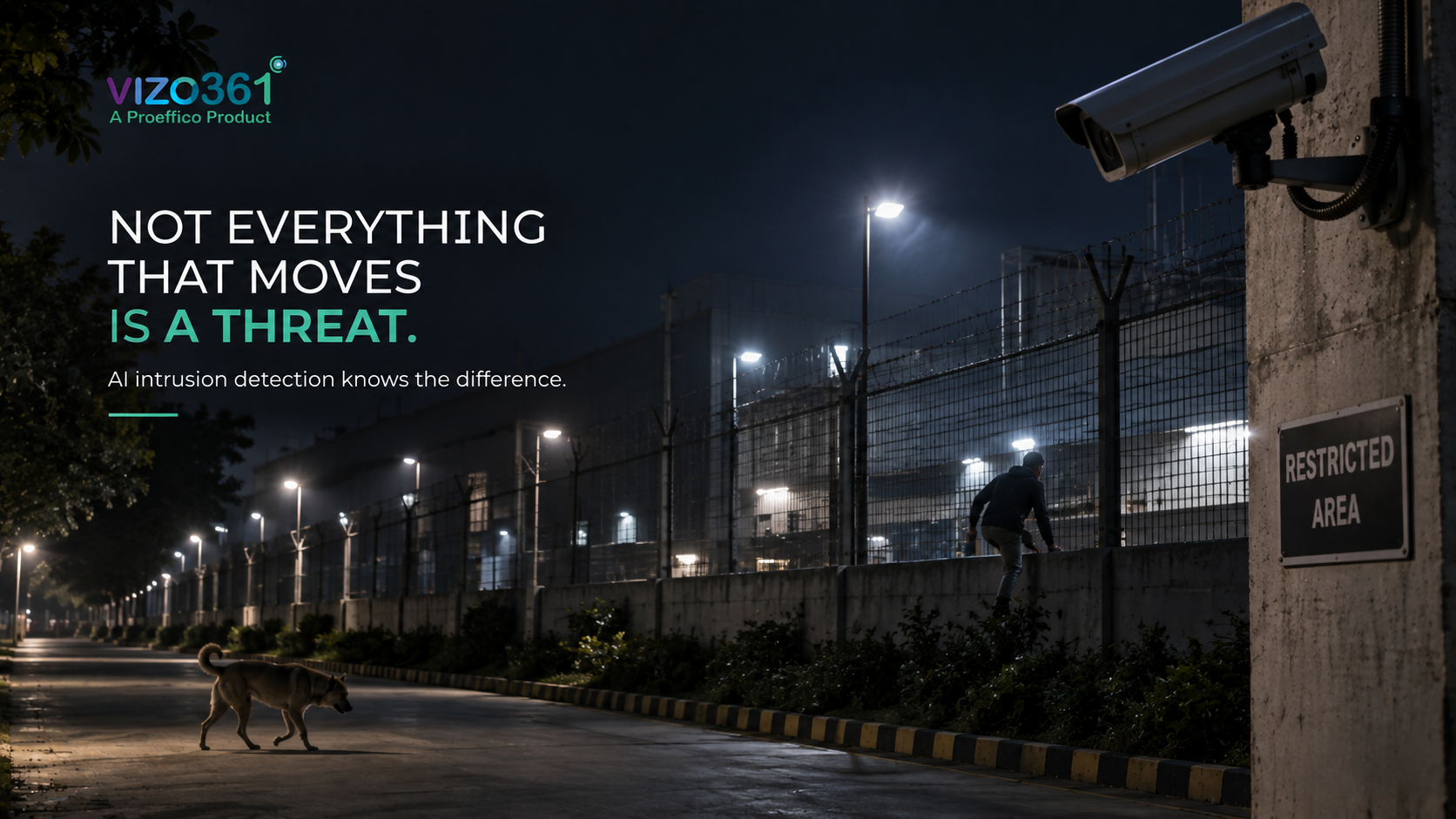
Restricted-zone and intrusion detection flags pedestrians in forklift-only corridors, unauthorized personnel near high-voltage switchgear, and after-hours movement in restricted stores or tool rooms. Forklift-pedestrian incidents remain one of the leading causes of serious injury in Indian warehousing and manufacturing — zone enforcement via camera is faster and more reliable than painted floor markings alone.
Phone-in-hand detection matters on production lines where phone use is both a distraction risk and an IP or trade-secret concern. Assembly and precision manufacturing plants frequently carry contractual confidentiality obligations with OEM customers; automated phone detection on the line is a defensible control.
ANPR (automatic number-plate recognition) at factory gates automates vehicle entry logs, flags unregistered transport at loading docks, and creates a searchable audit trail of material movement in and out of the plant.
Guard sleeping and inactivity detection ensures that nightshift security coverage holds — a common weak point in multi-shift plants where manual oversight of perimeter guards is impractical.
Works on the CCTV your factory already has
The capital expenditure question is the one that kills most safety technology proposals at the plant level. VIZO361 is built to sidestep it. The platform connects via RTSP/ONVIF to 40+ camera manufacturers — including the IP and analog brands most commonly installed in Indian industrial facilities — so the existing camera infrastructure becomes the sensor layer without a hardware refresh.
Edge processing keeps footage and analysis on-site. For factories with strict data-residency requirements — common in defence supply chains, government-adjacent manufacturing, and facilities handling proprietary process data — this means no footage leaves the building. The ISO 27001-backed platform generates audit-ready evidence logs that are exportable per zone and per shift, in the format compliance teams actually need.
A typical go-live scope covers camera-zone mapping, agent configuration, and alert routing to the supervisor on duty. This is not a multi-month IT infrastructure project. The engineering team brings a zone map and camera spec sheet to the first session; alert paths to plant floor hooters, the PA system, or a supervisor's phone are configured as part of deployment. VIZO361 for manufacturing plants is scoped to start delivering compliance logs within weeks, not quarters.
How to prioritise which agents to deploy first
The right starting point is not the most technically impressive agent — it is the hazard category with the highest incident frequency or the most recent audit finding. A plant that failed a Tier-1 OEM PPE audit last quarter starts with the PPE-compliance agent. A facility that had a fire incident in the chemical store starts with fire and smoke detection. The business case is clearest when the agent directly addresses the known risk on record.
A practical first deployment is two or three agents on a defined site — PPE compliance plus fire detection, for example — focused on generating one complete audit cycle of compliance logs before scaling to additional zones or plants. This is not timidity; it is the fastest way to prove log quality and alert response time to the management team that will approve the next phase.
False-alert rate is not a secondary concern. A system that fires on dust, welding sparks, or steam in a foundry, and gets muted by the supervisor in week two, is not an improvement on the clipboard — it is a more expensive version of the same gap. Any evaluation should include a two-week calibration period in actual production conditions, not just a demo environment.
Integration into the existing alert response path matters as much as detection accuracy. Analytics without a response path is data, not safety. Alerts that route to a supervisor's phone and trigger the plant hooter close the loop; alerts that only appear on a dashboard no one is watching do not.
Building the audit case for management
The business case for AI video analytics in Indian manufacturing resolves quickly once it is framed correctly. The comparison is not "platform cost vs. zero cost" — it is "platform cost vs. cost of one avoided incident, one failed audit, or one Factory Act enforcement action." That calculation nearly always favours deployment.
AI-generated shift logs give the EHS manager a defensible compliance record. When an OEM auditor asks for PPE compliance data by zone and shift for the past three months, the answer is an export, not a conversation. When a Factory Act inspector asks for evidence of ongoing PPE monitoring, the log timestamps speak before the safety officer does.
Cloud deployment supports multi-site visibility without VPN complexity — a single dashboard across plants in different states, with per-site alert management. On-premises deployment keeps all footage and processing internal for facilities where data residency is non-negotiable. Both options produce the same audit-ready logs. To understand the broader AI engineering capability behind VIZO361's agent architecture, Proeffico's AI engineering capability covers how the platform's detection models are built and maintained.
For context on how AI is being applied across Indian manufacturing operations more broadly — process automation, quality control, predictive maintenance — Proeffico's manufacturing AI work covers the full landscape beyond video analytics.
Frequently Asked Questions
Can AI video analytics run on the CCTV cameras already installed in my factory?
Yes. VIZO361 connects via RTSP/ONVIF protocols and is compatible with 40+ camera brands — covering the IP and analog hardware most commonly installed in Indian industrial facilities. No new cameras, no cabling project, and no capital expenditure for hardware are required to start generating safety data.
What PPE items can an AI camera detect on a factory floor?
VIZO361's PPE-compliance agent detects helmets, high-visibility vests, safety footwear, gloves, and face shields. Detection is configured per camera zone, because PPE requirements vary across a factory — the welding bay and the finished-goods store have different rules. The agent flags any person in frame who is missing a required item and routes an alert to the zone supervisor within seconds.
What format do the AI-generated PPE compliance logs come in — and can I use them for a Tier-1 OEM audit?
Each flagged event is automatically logged with zone, timestamp, camera reference, and a still image. The log is exportable per zone and per shift — exactly the format a Tier-1 OEM auditor or ISO 45001 assessor asks for. A three-month compliance log is a credible audit response; a clipboard check is not.
Does the system generate false alerts from steam, welding fumes, or factory dust?
False-alert rate is a genuine concern in Indian industrial environments. VIZO361's fire-watch agent is trained to distinguish combustion smoke from steam, dust, and welding fumes. The PPE agent is tuned for low-light and dusty conditions common in foundries and fabrication shops. A dedicated calibration sprint in weeks one and two of deployment is standard practice to reduce false positives before the system goes live on the floor.
What does a typical AI video analytics deployment look like in an Indian manufacturing plant — how long does it take?
A first deployment covers camera-zone mapping, agent configuration (typically PPE compliance and fire detection), and alert routing to the supervisor on duty or the plant floor PA system. This is not a multi-month IT infrastructure project. The engineering team works from a zone map and camera spec sheet; alert paths are configured as part of deployment. VIZO361 for manufacturing plants is scoped to start delivering compliance logs within weeks.
The bottom line
A safety policy that lives in a manual says what should happen. A safety record proves what did. AI video analytics on existing CCTV is the mechanism that closes that gap — converting continuous camera coverage into compliance logs, zone alerts, and audit evidence that a clipboard never could.
For Indian manufacturers facing Tier-1 OEM audit requirements, Factory Act obligations, and the operational realities of multi-shift production — dusty conditions, high turnover on the floor, nightshift coverage gaps — the question is not whether the technology works. It is which hazard category to address first.
To understand how video analytics surveillance works across different deployment contexts, the VIZO361 complete guide covers the broader evaluation framework. When you are ready to map agents to your specific zones and camera specs, book a VIZO361 manufacturing demo — bring your camera layout and the audit finding from last quarter. That is the fastest way to scope what an actual deployment looks like for your plant.