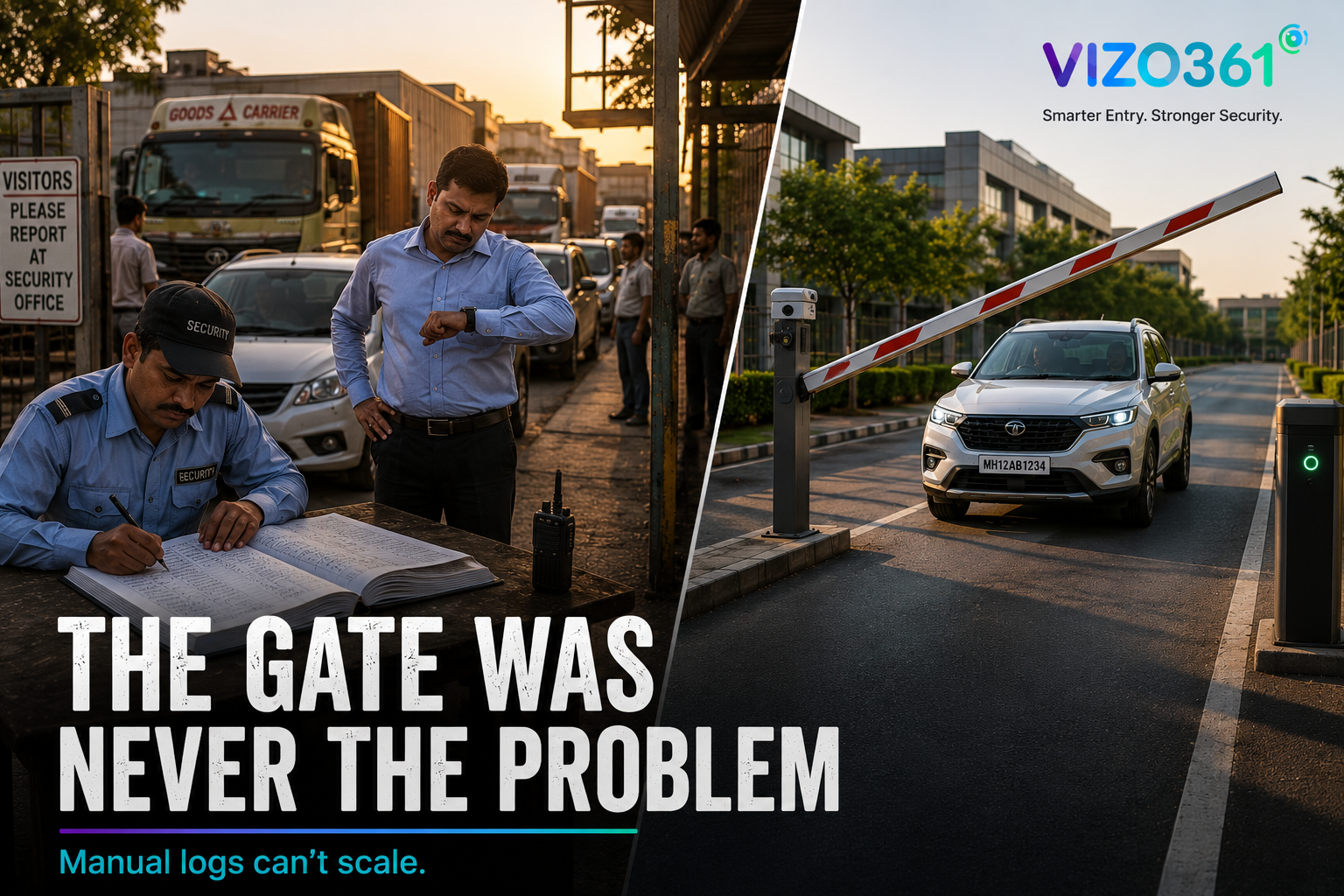
The security guard raising a boom barrier by hand is not the weak link. The problem is what he cannot do simultaneously: read every plate against a 200-entry watchlist, log the timestamp, cross-check the owner in VAHAN, and generate a monthly report — while three more vehicles queue behind the truck he is currently inspecting. An ANPR system in India does all of that before the barrier lifts.
This post covers what automatic number plate recognition actually does at an Indian gate, where it earns its keep, and the five questions worth asking before you commit to any system.
The problem with manual vehicle access in India
Manual gate logbooks have one structural flaw: they depend entirely on the person holding the pen. Plates get written down incorrectly, entries get skipped during busy shifts, and the logbook itself rarely gets indexed. If the operations head needs to know when a specific delivery truck entered the facility last Tuesday, the answer is buried in a physical register — if it was recorded at all.
The compliance exposure is equally real. Factories and corporate campuses that handle sensitive materials or restricted zones often carry an obligation to maintain an auditable vehicle entry trail. A spiral-bound notebook does not satisfy that requirement in any meaningful way. Insurance investigators and internal audit teams increasingly ask for timestamped, image-backed records.
And then there is the throughput problem. A single guard managing two lanes at peak shift-change — say 7:45 AM at a manufacturing plant — cannot physically inspect every plate against a blacklist and maintain queue speed. Something gets skipped. Usually, the gate opens and the guard fills the log retrospectively from memory.
An ANPR system closes all three gaps at once: read → match → act → log, every vehicle, every time.
What VIZO361's ANPR-Sentinel agent does
VIZO361's ANPR-Sentinel agent reads vehicle number plates in real time from the IP or analog cameras already installed at your gate. No proprietary camera required. The agent sends the OCR'd plate string to a matching engine that checks three sources in parallel: your whitelist of authorised vehicles, your blacklist of flagged plates, and — where configured — the VAHAN/RTO database for registered owner details.
Indian plates are not a single standard. The ANPR-Sentinel agent handles the full range in daily use across the country:
- White plates — private vehicles, the most common at corporate campuses and housing societies
- Yellow plates — commercial vehicles including goods trucks and passenger transport
- Green plates — EVs, increasingly common in newer fleet and campus environments
- HSRP (High Security Registration Plates) — the IND-prefix format rolling out progressively across states
Beyond format variation, Indian field conditions introduce their own challenges: mud obscuring the lower digits on delivery trucks, glare on metal plates at midday, scratched embossed plates on older vehicles, and low-angle capture at sites where the camera was not originally positioned for ANPR. The agent's recognition pipeline is tuned for these real-world conditions rather than a laboratory ideal.
On a whitelist match: the barrier controller receives a trigger via relay or API, the gate opens, and a timestamped log entry is written with a plate image attached. On a blacklist hit: the barrier stays closed and a security officer receives an alert — plate image, flagged reason, and timestamp — within seconds.
Where it deploys — India use cases
The same core agent adapts to substantially different site types, each with its own operational need:
Factory gate and industrial sites: Employee vehicles enter automatically without a guard needing to lift a phone. Contractor vehicles are logged with every visit timestamp. Unscheduled delivery trucks are flagged before they reach the dock. For sites covered under VIZO361 for factory and industrial sites, ANPR typically pairs with PPE detection and perimeter zone monitoring as part of a broader access and safety layer.
Corporate campus and IT park: Frictionless entry for registered staff is the headline benefit, but the audit trail is often what IT security and compliance teams care about most. Visitor vehicles can be pre-registered against the expected arrival time — the gate opens when the plate matches, not when someone at reception picks up a phone.
Mall and commercial parking: Entry and exit timestamps underpin time-based billing. The ANPR log becomes the billing record and the dispute-resolution record in one.
Gated housing society: Resident vehicles enter without the guard needing to physically inspect or wave through. Unrecognised vehicles trigger a verification step rather than a default wave-through on a busy morning.
Logistics dock: Every vehicle in and out is logged with a plate image. When a shipper disputes a delivery window, the timestamped ANPR record is faster and more reliable than re-interviewing the shift guard.
Hospital and healthcare facility: Ambulance bay management and service vehicle scheduling benefit from a system that recognises and prioritises specific plates without manual coordination at the entrance.
Integration: how it connects to boom barriers and your existing systems
The practical question most facilities managers ask first is whether they need to replace their existing barrier controller. In most cases, the answer is no. VIZO361's ANPR-Sentinel integrates with IP-controlled boom barriers and gate controllers via relay output or API — the agent sends the open signal; the controller handles the mechanical actuation. No proprietary hardware is introduced into the loop.
Alert routing is configurable: SMS to a guard's phone, email to a supervisor, or a dashboard alert on a tablet at the guardhouse. Sites with an existing security operations centre can route alerts into the monitoring workflow they already use.
The log is searchable and exportable. Filtering by date range, plate string, or entry-exit pair takes seconds rather than the hour it takes to page through a physical register. Monthly security reports and audit submissions become a query, not a manual exercise.
Where no camera is currently positioned for gate capture, the recommended minimum camera specification is modest — a fixed IP camera at an appropriate angle and resolution. The agent does not require a specialised ANPR camera, which keeps deployment cost substantially lower than proprietary systems that bundle hardware into the contract.
For a broader view of how video analytics turns cameras into action across fire, PPE, footfall, and cash-counter use cases, VIZO361's complete guide covers the full agent stack.
What to check before buying any ANPR system for an Indian site
The vendor demos are all impressive. The questions that separate capable systems from ones that underperform in real Indian conditions are not asked during the presentation — they should be asked before you sign.
- Does it handle all Indian plate formats — including HSRP, EV green plates, and older embossed plates? HSRP rollout is uneven across states, and many sites see a mix of old and new formats on the same day. A system tuned only for HSRP will miss a material share of plates at most Indian facilities.
- What is the real-world accuracy rate — not the lab figure? Ask specifically about performance in dust, rain, direct glare at noon, and low-light capture at 4 AM. Request data from a comparable deployment, not a controlled demo.
- Does it run on your existing cameras, or does the vendor require their own hardware? Proprietary hardware requirements can multiply the total project cost by two to three times. Camera-agnostic systems keep the upgrade cost predictable.
- How does the alert reach the guard on duty — and how quickly? An alert that arrives 90 seconds after a blacklisted vehicle has already entered is useful for the log but not for the intervention.
- Where does the data live? For factories near sensitive industrial zones, government-adjacent campuses, or any site with internal data-residency requirements, on-premise storage is often non-negotiable. Confirm whether the vendor supports on-prem, cloud, or hybrid deployment before the conversation goes further.
Frequently Asked Questions
How does an ANPR system work at an Indian gate or parking facility?
The system captures an image of the vehicle's number plate as it approaches, runs optical character recognition (OCR) to read the plate string, checks it against your whitelist, blacklist, and optionally the VAHAN/RTO database, and then either triggers the boom barrier to open or sends an alert to the security officer — all before the vehicle has stopped. A timestamped log entry with a plate image is written automatically on every transaction.
Does VIZO361's ANPR-Sentinel handle all Indian plate formats, including HSRP and EV green plates?
Yes. The ANPR-Sentinel agent is built for the full range of plates in daily use across India: white plates (private vehicles), yellow plates (commercial vehicles), green plates (EVs), and HSRP high-security registration plates with the IND-prefix format. The recognition pipeline also handles real-world conditions such as mud obscuring digits, glare, scratched embossed plates on older vehicles, and low-angle capture at sites where the camera was not originally positioned for ANPR.
Does the ANPR system require replacing our existing boom barrier or gate controller?
In most cases, no. VIZO361's ANPR-Sentinel integrates with IP-controlled boom barriers and gate controllers via relay output or API — the agent sends the open signal and the existing controller handles the mechanical actuation. No proprietary hardware is introduced into the control loop.
Where is the vehicle entry log stored, and who can access it?
The log is searchable and exportable from the VIZO361 dashboard. You can filter by date range, plate string, or entry-exit pair in seconds. For sites with data-residency requirements — factories, government-adjacent campuses, or sensitive industrial zones — VIZO361 supports on-premise deployment, keeping all footage and log data on-site. ISO 27001 certification covers how data is stored and accessed.
What is the real-world accuracy of ANPR in Indian field conditions — dust, rain, glare, and low light?
Vendor-quoted accuracy figures are typically measured under controlled conditions. Real-world performance in Indian sites — dust on delivery trucks, noon-time glare on metal plates, low-light capture at 4 AM — is what determines whether the system is usable in daily operations. Any evaluation should include a live plate-read test on your own cameras before contract sign-off.
The bottom line
An ANPR system does not replace your security team. It removes the tasks that exhaust them — plate-reading under time pressure, manual logging, real-time blacklist checking — so they can focus on what actually requires human judgment. The logbook disappears. Vehicle throughput improves. Every entry and exit is timestamped, image-backed, and searchable from the day the system goes live.
For enterprise campus environments, the access control layer extends further — VIZO361 for enterprise campus security combines ANPR with facial recognition and guard monitoring into a unified access picture. For sites where ANPR is the first deployment, the agent runs independently from day one.
VIZO361 is a product of Proeffico's enterprise security AI practice — the same ISO 27001-certified engineering capability that backs every agent in the stack.
The fastest way to evaluate whether ANPR-Sentinel fits your site is a camera-compatibility check and a live demonstration on your own feed. Book a VIZO361 ANPR-Sentinel demo and the team will confirm camera compatibility, cover the integration path for your barrier controller, and run a plate-read test before any commercial conversation begins.