Every Indian factory has a PPE policy. Most also have cameras covering the floor. The gap between policy and proof — what a Tier-1 OEM auditor actually asks for, what a Factory Act inspector actually needs to see — is where manual PPE monitoring consistently falls short. AI PPE detection cameras close that gap by turning the CCTV already installed in your plant into a continuous compliance record, zone by zone, shift by shift.
This post covers what AI PPE detection actually monitors, what it cannot do, and how to deploy it practically inside the real conditions of an Indian factory — dust, steam, low light, and all.
Why manual PPE checks are failing Indian factories right now
A floor supervisor cannot watch every camera zone at the same time. On a three-shift production floor, that means violations happen continuously in the spaces between rounds — a worker removes their helmet in a heat bay, a contractor walks through a chemical zone without a high-vis vest, a shift changeover creates a twenty-minute gap in PPE oversight. None of it lands on a clipboard.
The compliance pressure has moved beyond internal policy. Tier-1 OEM customers in auto, pharma, and FMCG supply chains now routinely ask for per-zone, per-shift PPE compliance logs as part of supplier qualification audits. A clipboard-based check produces a snapshot; an OEM auditor wants a timestamped record. If that record does not exist, the non-conformance finding goes on file — and the next qualification round gets harder.
India's regulatory frame adds personal liability into the equation. The Factory Act, 1948 mandates PPE in designated hazardous zones, and non-compliance that leads to injury can result in prosecution of the safety officer — not only a facility fine. ISO 45001 certification, increasingly required by international buyers, demands evidence of documented, repeatable monitoring processes. A post-incident CCTV review is evidence of what went wrong; an AI-generated shift log is evidence that the monitoring system was running.
What AI PPE detection actually monitors — and what it cannot
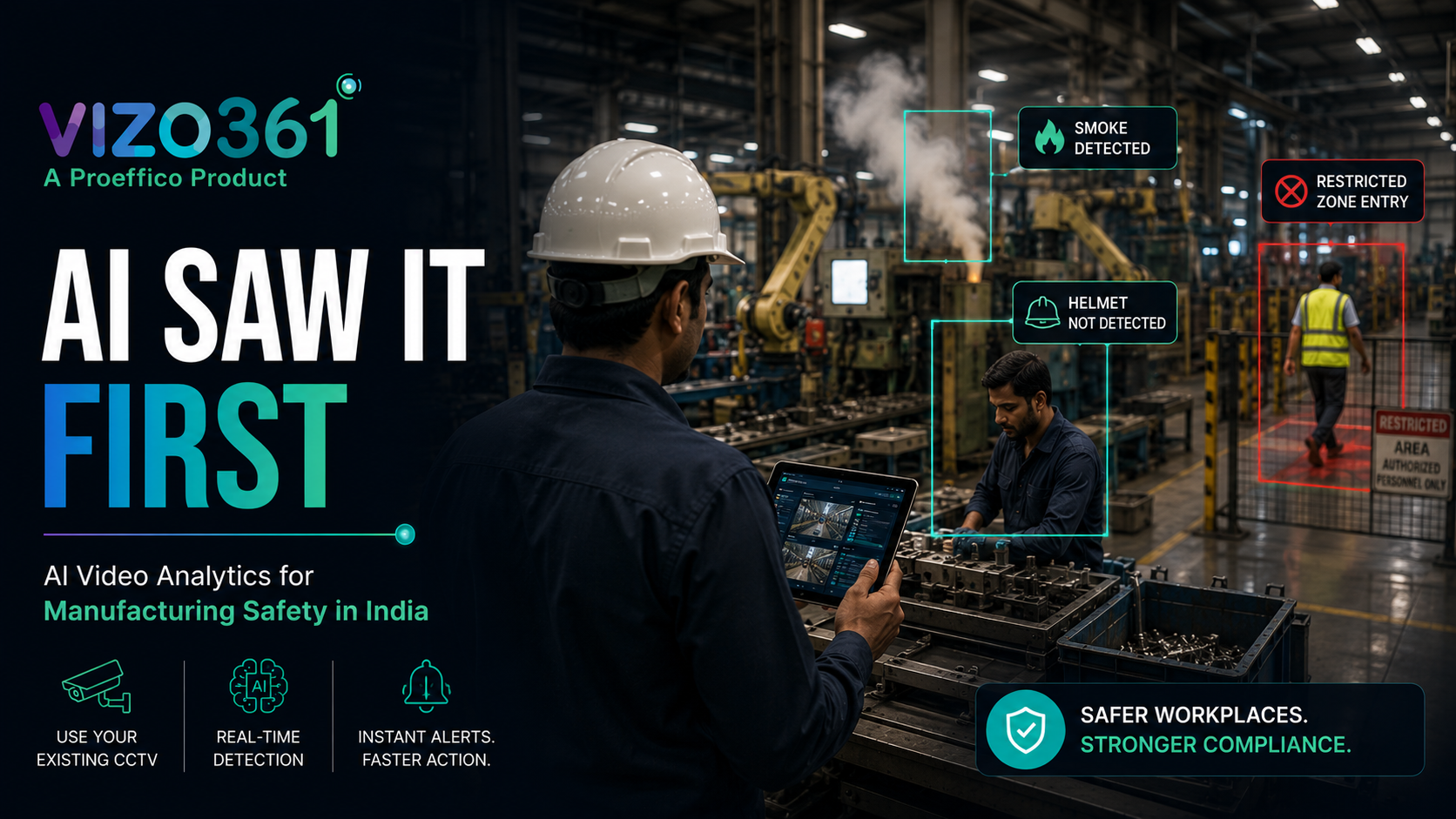
VIZO361's PPE-compliance monitoring agent works at the camera-zone level. You configure which PPE items are required in each zone — helmets and safety footwear at the lathe bay, high-vis vest and gloves at the chemical store, face shield at the welding station — and the agent flags any person in frame who is not wearing the required item. The alert reaches the zone supervisor within seconds, not at end of shift.
The detectable items cover the gear that PPE programmes most commonly specify: helmets, high-visibility vests, safety footwear, gloves, and face shields. Because zone configuration is per-camera rather than site-wide, the system handles the reality of Indian factory floors where PPE requirements vary significantly between areas — the finished-goods store and the foundry bay are different environments and should be monitored differently.
Every flagged event is timestamped and annotated with zone, camera, and a still image — automatically. That is the per-shift compliance log an OEM auditor or ISO 45001 assessor will ask to see.
There are accurate limits to set with the safety team upfront. The agent detects PPE that is visibly absent; it does not detect PPE worn incorrectly but visually present — a helmet on the head with the chin strap undone registers as compliant. That distinction matters for programme design: AI handles continuous coverage and documentation, and targeted supervisor checks handle gear condition. The two work together better than either does alone.
Works on your existing factory CCTV
The capital expenditure question blocks most safety technology proposals before they reach management. VIZO361 is designed around that constraint. The platform connects via RTSP/ONVIF to 40+ camera brands — covering the IP and analog hardware most commonly installed in Indian industrial facilities — so no new cameras, no cabling project, and no infrastructure refresh are required to start generating PPE compliance data.
Edge processing keeps all footage and analysis on-site. For plants in pharma, defence supply chains, or facilities handling proprietary process data, that means video never leaves the building. The ISO 27001-certified platform generates exportable audit logs without routing footage to a third-party cloud.
A go-live scope covers camera-zone mapping, PPE rule configuration per zone, and alert routing to the zone supervisor — whether that is a plant-floor PA system, a supervisor's mobile, or both. VIZO361 for manufacturing plants is scoped to start generating shift logs within weeks, not after a months-long IT implementation cycle.
How to deploy: start from the highest-risk zone
The right starting point is not the most technically impressive zone — it is the area with the highest violation frequency or the most recent audit finding. A plant that failed an OEM PPE audit last quarter starts the PPE-compliance agent at the zone that triggered the finding. Proof of detection accuracy and alert response time in that zone over three to four weeks is the basis for management approval to expand.
False-alert tuning is not optional. A foundry bay with steam or a cold-store with thick winter gear will generate false flags on a system that has not been calibrated for the environment. Plan a dedicated tuning sprint in weeks one and two — this is the step that determines whether the system stays active or gets muted. An alert that generates no response because the supervisor learned to ignore it is not a safety control.
Integrate alerts into existing response infrastructure. An alert with no action path is data, not safety. Routing to the zone supervisor's phone and the plant floor PA system closes the loop. For broader fire and smoke detection for factory safety, the same alert-routing logic applies — detection only creates value when the response chain is wired in from day one.
Building the audit case: shift logs as compliance evidence
The VIZO361 PPE-compliance agent generates shift logs in the format compliance teams actually use: zone, timestamp, camera reference, and a violation image. An ISO 45001 auditor or Tier-1 OEM representative can consume this directly — it is not a summary report, it is a primary record.
The management dashboard shows compliance rate by zone and by shift. That view identifies which area and which shift lead need attention — making the data operational, not just archival. A three-month log is a credible response to a customer audit. A full year demonstrates a functioning system, not a one-off compliance effort ahead of a visit.
For context on the AI engineering behind VIZO361's detection agents, Proeffico's manufacturing AI work covers how detection models are built and maintained for Indian industrial environments. Proeffico's broader process automation for industrial operations shows how AI monitoring fits into a wider operational improvement programme.
Frequently Asked Questions
What PPE items does an AI detection camera actually identify in a factory environment?
VIZO361's PPE-compliance agent detects helmets, high-visibility vests, safety footwear, gloves, and face shields. Because PPE requirements differ by zone — a welding station and a chemical store have different rules — detection is configured per camera zone rather than as a site-wide setting. The system flags any person in frame who is missing a required item for that specific zone.
Can AI PPE detection cameras generate the compliance logs that Tier-1 OEM auditors ask for?
Yes. Every flagged event is automatically timestamped and annotated with zone, camera reference, and a still image of the violation. These records are exportable per zone and per shift — the exact format a Tier-1 OEM auditor or ISO 45001 assessor requests. A clipboard-based check produces a snapshot; an AI-generated log produces a continuous, searchable record across every zone and every shift.
Does AI PPE monitoring work on the cameras already installed in my factory?
VIZO361 connects via RTSP/ONVIF to 40+ camera brands — covering the IP and analog hardware most commonly installed in Indian industrial facilities. No new cameras, no cabling project, and no capital expenditure for hardware are required. Edge processing means all footage stays on-site, which is important for factories in pharma, defence supply chains, or facilities handling proprietary process data.
What can an AI PPE detection camera not catch — and where does manual oversight still matter?
The agent detects PPE that is visibly absent. It does not detect PPE worn incorrectly but visually present — for example, a helmet on the head with the chin strap undone registers as compliant. This distinction matters for programme design: AI handles continuous coverage and documentation; targeted supervisor checks should cover gear condition and correct fit. The two approaches work better together than either does alone.
What PPE is legally required in Indian factories under the Factory Act?
The Factories Act, 1948 requires employers to provide and enforce PPE use in designated hazardous zones — including areas involving chemical exposure, heavy machinery, electrical risk, and construction-adjacent activities. Specific BIS standards govern the type and grade of helmets, vests, and footwear required by hazard category. Non-compliance in a zone that leads to a serious injury can result in personal prosecution of the factory manager, not only a facility fine.
Conclusion
AI PPE detection cameras turn a safety policy into a continuous record — and a continuous record into audit-ready evidence. For Indian factories managing Tier-1 OEM audit cycles, Factory Act obligations, and the operational reality of multi-shift production, the technology is not experimental. The question is which zone to instrument first and what the alert response path looks like on your floor.
For a broader look at AI video analytics for manufacturing safety in India, the VIZO361 manufacturing post covers the full agent set — PPE, fire detection, restricted zones, and ANPR — in a single deployment context. When you are ready to map the PPE-compliance agent to your specific zones and camera specs, book a VIZO361 PPE-compliance demo — bring your zone map and the audit finding from last quarter. That is the fastest way to scope what deployment looks like for your plant.